Press Statement
Date: August 22, 2026
People’s BRICS Summit Demands Concrete, Time-Bound Action on People’s Demands
New Delhi: The resolution passed at the People’s BRICS Summit demanded that the “South-South cooperation” be recognised not by the sovereignty it grants to states and capital, but by the freedom, security and dignity it delivers to working people, farmers, workers, women, dalits, adivasis, minorities and communities across the Global South.
The resolution asserted that the BRICS continues to be viewed as a potential challenge to western economic and financial dominance, its potential and promise to break away from colonial mindsets and logic and build an alternative world order remain unfulfilled, and BRICS member countries continue to reproduce extractivist and inequitable development, and advance neoliberal trade and investment, corporate concentration, privatisation and financialisation, which have resulted in widespread destruction of eco-systems and livelihoods, violation of peoples’ rights, forced displacement of entire populations.
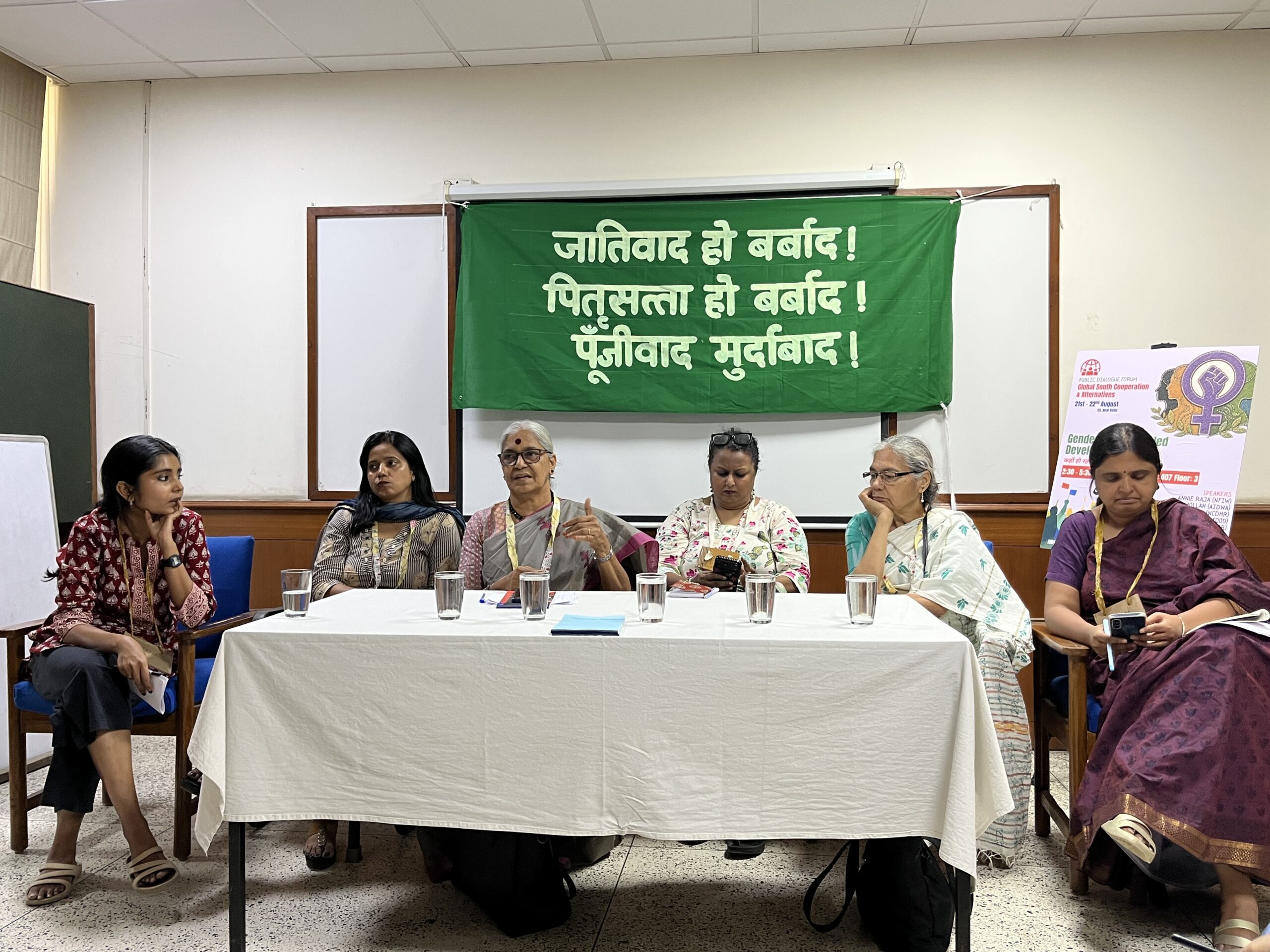
The People’s BRICS Summit – the Public Dialogue Forum: Global South Cooperation & Alternatives, held in New Delhi on August 21-22. Over 200 delegates from around the country, representing people’s movements, political parties, trade unions, student movements and civil society organisations, took part in the deliberations, which included 10 workshops on various issues.
The resolution demanded the BRICS to take concrete, time-bound commitments to reduce inequality within and between countries, develop South–South cooperation that breaks with extractive and unequal development models, and promotes food sovereignty, strong public investment in agriculture, accessible institutional credit, universal and effective crop insurance, the right to universal social security, pensions, healthcare, unemployment protection and income security across the life course for all workers and trade policies that preserve the policy space of developing countries to industrialise, protect strategic sectors, regulate capital, pursue full employment and drive structural transformation, while safeguarding people and the environment.
It also demanded the BRICS take a clear stand against unlawful military intervention, occupation, genocide, ethnic cleansing, collective punishment and coercive measures.
People’s BRICS expressed solidarity with the people of Palestine and decried the fascist occupation by zionist forces.
Speaking at the opening plenary, former Professor of International Affairs at the Jawaharlal Nehru University and an international affairs expert Anuradha Chenoy said, “While BRICS has the potential to stand up to the hegemony of the West, and challenge the existing structures of global power, we have to wait and see whether they will go beyond the rhetoric and live up to the expectations.”
The opening plenary of the People’s BRICS also had senior trade unionist Shaktiman Ghosh, National Hawkers Federation; Anjali Bhardwaj, Satartk Nagarik Sangathan; Beena Pallical, National Campaign on Dalit Human Rights; Prafulla Samantara, Lok Shakti Abhiyan; and development economist and gender specialist Ritu Dewan.
The resolution demanded that the BRICS steers a democratic, publicly accountable and community-led just energy transition that expands universal access to clean energy while protecting livelihoods, ecosystems and community rights. Further, it demanded debt restructuring & de-dollarisation, political representation and decision-making power for women at every level, protection of citizenship and political rights from digital exclusion, democratic and public-interest governance of data and digital infrastructure, stronger drug regulation, safety and quality oversight, with transparent and accountable regulatory institutions. The resolution emphasised the centrality of peoples’ rights and participatory democracy as conditions for building an alternative world order, and asked BRICS members to implement their obligations under international human rights law, and stop the persecution of individuals, groups and organisations for their political views, race, ethnicity, religion and/or gender.
Workshops were held on the topics of Trade, Agriculture, Labour, Natural Resources, Inequality, Energy & Climate, Alternative Financial Architecture, Gender, Political Economy of AI and Technology & Democracy.
There were many speakers at these workshops including, Jaya Mehta, Joshi Adhikari Institute for Social Studies; Bappa Sinha, Free Software Network; Ashim Roy, trade unionist; Harjeet Singh, Satat Sampada Climate Foundation, Soumya Dutta, MAUSAM; Rakshita Swamy, SAFAR; Radhika Chatterjee, Third World Network; Anirban Bhattacharya, Centre for Financial Accountability; Annie Raja, National Federation of Indian Women; Maimoona Mollah, All India Democratic Women’s Association; Dipa Sinha, Right to Food Campaign; Dinesh Abrol, academic/activist; Nidheesh Villat, All India Kisan Sabha; Prof. Arun Kumar, Economist; Shreya Ghosh, Sangrami Gharelu-kamgaar Union, Rakhi Sehgal, Labour Activist and Researcher; Anjali Deshpande, Researcher; Avinash Kumar, Wada Na Todo; Nikhil Dey, Mazdoor Kisan Shakti Sangathan; Rohan Mathews, Focus on the Global South; Akash Bhattacharya, All India Central Council of Trade Unions; Krithika Dinesh, National Alliance for Climate and Ecological Justice; Adv Ritwik Dutta, LIFE; Roma Malik, All India Union of Forest Working People; Sripath Roy Koganti, Green Visakha; Abhijit Das, former head, Centre for WTO Studies; Prakriti, Researcher; Amrita Johri, Satark Nagrik Sangathan; Maansi, Voter Adhikar Manch and Parminder Singh, tech policy analyst.
The workshops were organised by National Alliance of People’s Movements (NAPM), Focus on the Global South, Movement for Advancing Understanding of Sustainability And Mutuality (MAUSAM), National Alliance for Climate and Ecological Justice (NACEJ), Mazdoor Kisan Shakti Sangathan, Satartk Nagarik Sangathan, Forum for Trade Justice, Green Vishaka, Lok Shakti Abhiyan, Pagdandi Collective, Social Accountability Forum for Action and Research (SAFAR), All India Democratic Women’s Association (AIDWA), National Federation of Indian Women (NFIW), Friends of the Earth India, Right to Food Campaign; National Campaign on Dalit Human Rights (NCDHR), Joshi Adhikari Institute for Social Studies, Free Software Network, Centre for Financial Accountability and others.
The People’s BRICS concluded with an expression of solidarity with farmers, workers, women, and marginalised communities across BRICS countries and beyond. Participants reaffirmed their commitment to strengthening mutual solidarity and support, sharing experiences, and learning from one another as they continue their respective struggles for justice, dignity, equality, and a more just and democratic world.
Images: https://drive.google.com/drive/folders/12i4VxOp4Ejv6oR_6U6EZs0QBradO-oqM?usp=sharing
Contacts:
Anjali S. – anjali@cenfa.org | 81305 80438
Joe Athialy – joe@cenfa.org | 98711 53775
Centre for Financial Accountability is now on Telegram and WhatsApp. Click here to join our Telegram channel and click here to join our WhatsApp channeland stay tuned to the latest updates and insights on the economy and finance.