
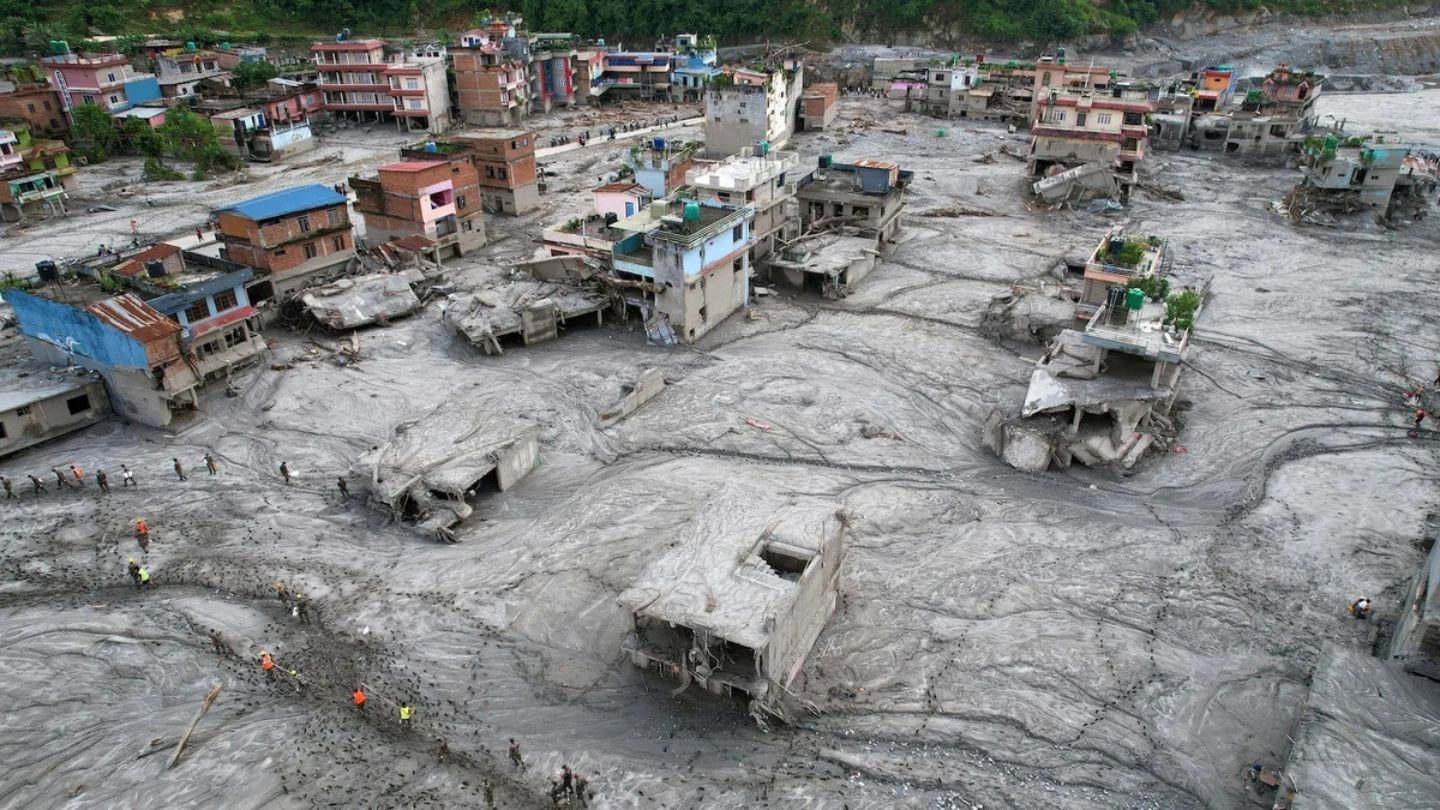
The catastrophic Lhende Khola-Bhotekoshi-Trishuli disaster in Nepal on August 26 has produced an important political response from Kathmandu. Nepal is not merely presenting itself as a victim in need of charity. It is asserting a right to climate justice: to international finance, particularly grants from the global climate-finance and Loss-and-Damage architecture, to meet losses that a profoundly climate-vulnerable country increasingly cannot bear alone.
As an Indian climate and ecological-justice activist who has consistently supported the climate-justice demands of Nepal and other countries of the Global South, I strongly support this principle.
But there is also an important qualification :
Climate justice must be based on historical responsibility, capacity and per-capita emissions—not simply on the gross emissions of countries today. And in that framework, India should not be placed in the same responsibility category as the historically high-emitting industrialised countries.
Nepal’s demand is fundamentally legitimate
The scale of the Lhende khola- Bhotekoshi-Trishuli catastrophe makes the argument impossible to ignore. More than 1,000 people have been confirmed dead and thousands remain missing, while settlements, roads, bridges, hydropower infrastructure and livelihoods have been devastated. Nepal’s government has activated its diplomatic machinery to secure grants for reconstruction and resettlement and has formally approached the Fund for Responding to Loss and Damage.
This is not simply an argument about one flood. The Himalaya is warming rapidly, glaciers are retreating, permafrost and ice-rock systems are destabilising, and the hydrological cycle is becoming more volatile. The recent disaster involved an extraordinary combination of ice, rock, water and debris. Climate change does not necessarily create every individual disaster, but it increasingly changes the background conditions under which such hazards occur and can amplify their consequences. Recent scientific work on Nepal’s climate-induced loss and damage has specifically examined attribution and the country’s institutional readiness to access international support.
And Nepal’s contribution to the problem is tiny.
That is the essence of climate injustice: those with extremely small historical contributions to global warming can suffer some of its most destructive consequences. Nepal’s position therefore deserves solidarity—not only from Europe and North America, but from fellow South Asian countries.
Pakistan suffered the same injustice recently.
Pakistan’s catastrophic 2022 floods are perhaps the clearest recent South Asian example. One-third of the country was submerged and around 33 million people were affected. The World Bank-led Post-Disaster Needs Assessment estimated $14.9 billion in direct damage, $15.2 billion in economic losses and at least $16.3 billion in reconstruction and rehabilitation needs. Mind boggling losses for a country in the low economic development category!
Pakistan contributed less than 1% of global greenhouse-gas emissions, yet suffered a catastrophe whose economic and human consequences were enormous.
An IIT Gandhinagar study found that the extraordinary 2022 flooding was driven principally by about 15 days of extreme precipitation occurring over already saturated soils, while the wider scientific literature recognises the increasing vulnerability of South Asia under a warming climate.
Pakistan’s experience should therefore be part of the same climate-justice argument Nepal is now advancing.
Nor is this only a Himalayan problem alone.
The injustice extends to cyclone-prone poorer countries.
Cyclone Idai devastated Mozambique, Malawi and Zimbabwe in 2019. New attribution research finds that climate-change-related changes in rainfall, sea level and wind increased the resulting flood damage; when the different climate-affected drivers are combined, 8–35% of the flood damage in the Mozambique case was attributable to climate change.
The same structural injustice is visible across Africa, small island states and South Asia: countries with limited historical responsibility often have the least fiscal capacity to rebuild.
And India itself is increasingly experiencing this contradiction.
India is now among the world’s largest (3rd largest, by current annual emissions) annual emitters largely because of its enormous population and rapidly growing development needs. But Indian people—particularly farmers, informal workers, coastal communities, Himalayan populations and the urban poor—are also suffering from climate-amplified heat, floods, cyclones, droughts and extreme rainfall.
Climate justice must therefore recognise both sides of India’s reality: India is a major present-day emitter, but it is also a developing country with relatively low emissions per person and enormous internal climate vulnerability.
This is where Nepal’s framing needs correction.
If Nepal’s current political messaging identifies India as one of the countries responsible for its climate losses while failing to foreground the historically enormous contribution of the United States, European countries, Russia, Japan, Canada, Australia and other industrialised economies, that would be an unfortunate and politically counterproductive framing.
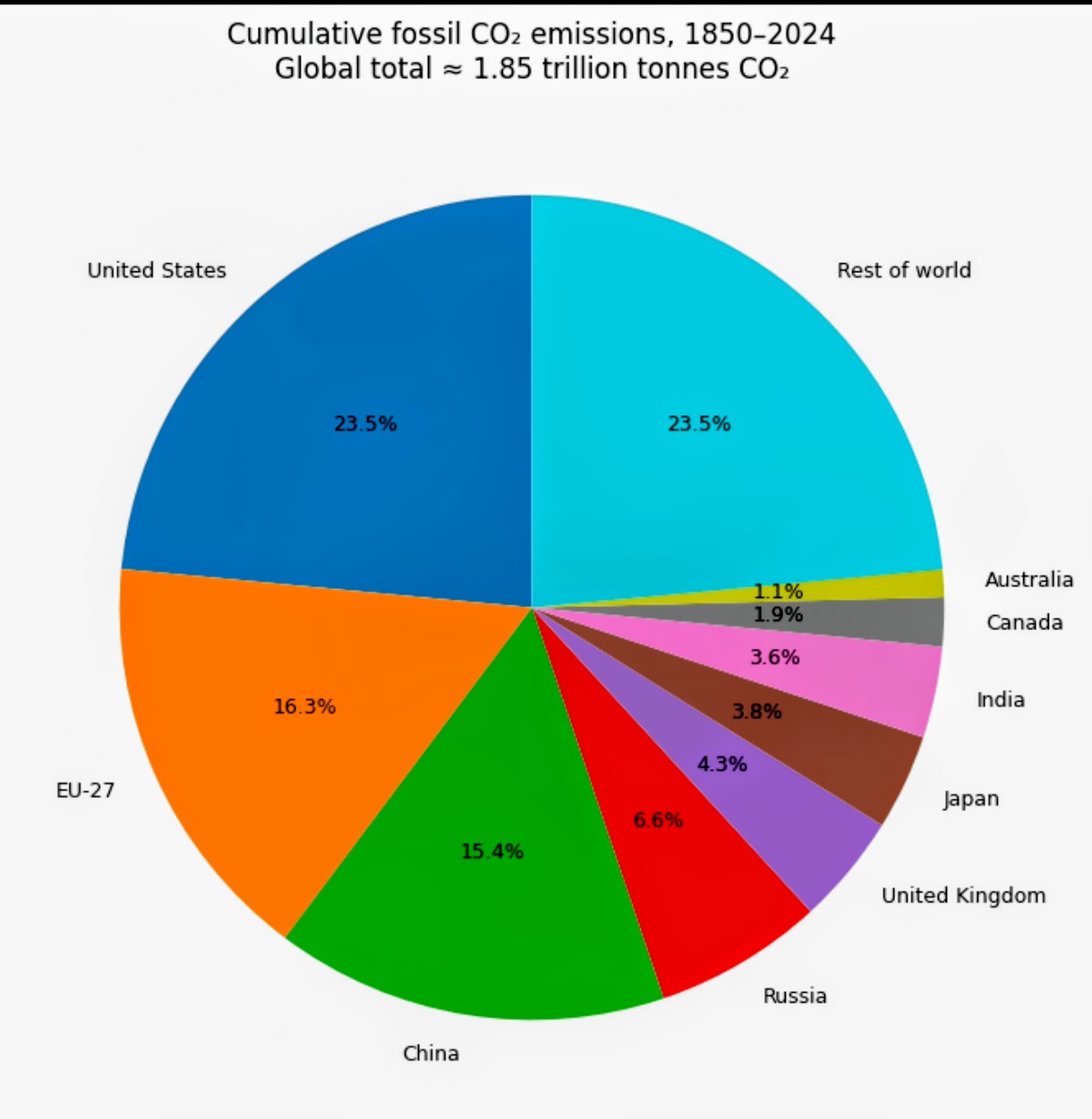
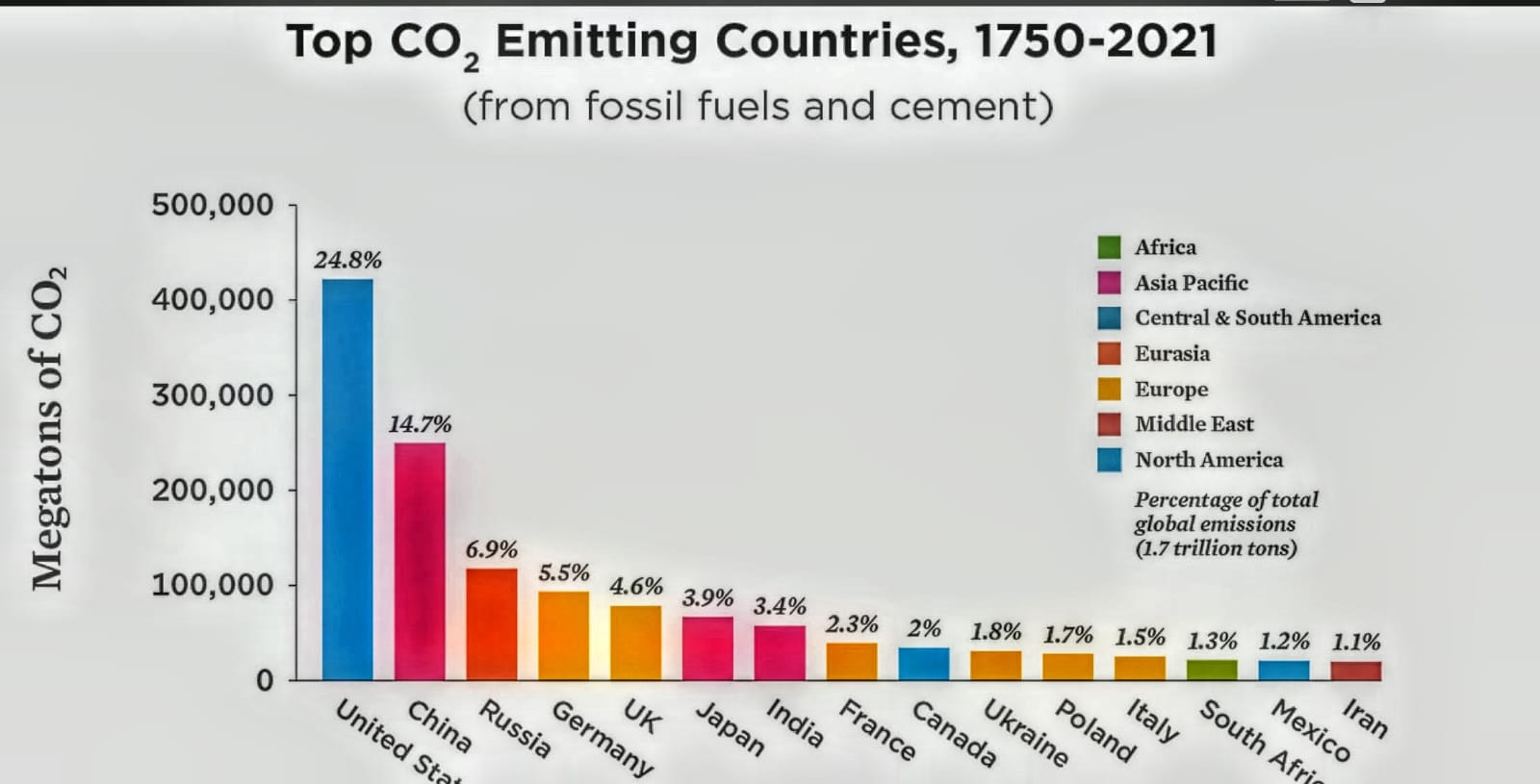
The historical numbers are stark.
The latest Global Carbon Budget/Our World in Data dataset estimates cumulative fossil-fuel and industrial CO₂ emissions of approximately:
| Country/region | Cumulative CO₂, 1850–2024 |
|---|---|
| United States | 434.9 Gt |
| EU-27 | 300.9 Gt |
| China | 285.1 Gt |
| Russia | 122.8 Gt |
| United Kingdom | 80.1 Gt |
| Japan | 69.6 Gt |
| India | 66.1 Gt |
| Canada | 35.6 Gt |
| Australia | ~20 Gt |
The global total is approximately 1.85 trillion tonnes.
The contrast becomes even sharper when population is considered.
India’s 2024 per-capita fossil CO₂ emissions were approximately 2.2 tonnes /year, compared with 14.2 tonnes for the United States, 13.4 for Canada, 14.5 for Australia and 5.4 for the EU-27. The global average was about 4.7 tonnes.
So India’s 66 billion tonnes of cumulative CO₂ cannot be interpreted in the same moral and historical framework as America’s roughly 435 billion tonnes.
Indeed, the Global Carbon Budget’s historical assessment shows that the United States alone accounts for a vastly greater cumulative contribution than India. Europe also accumulated enormous emissions before most of today’s developing world had industrialised.
But gross emissions alone are not enough
There is another important trap.
If gross national emissions become the sole measure of responsibility, the principle of climate justice collapses.
A hypothetical small country with a tiny population could say to Nepal: you emit more tonnes of CO₂ than we do, therefore you are more responsible.
That would be absurd.
The climate does not recognise national borders, but climate justice must recognise population, historical development, capacity, consumption, per-capita emissions and cumulative atmospheric contribution.
A credible responsibility framework should therefore consider at least:
historical cumulative emissions + present emissions + per-capita emissions + ability to pay + development needs + vulnerability + consumption-based emissions.
This is why the old UNFCCC principle of common but differentiated responsibilities and respective capabilities (CBDR-RC) remains so important.
The answer is solidarity among the Global South :
India should not respond defensively to Nepal’s climate-justice demand.
Instead, India should say :
Yes—Nepal deserves climate justice. Pakistan deserves climate justice. Bangladesh deserves climate justice. Small island states deserve climate justice. India’s vulnerable communities deserve climate justice. And historically high-emitting wealthy countries must provide substantially greater finance for adaptation and Loss and Damage.
That would be a far stronger position than turning Nepal and India into competing claimants.
There is an attractive possibility here.
The countries of the Global South—including India, Nepal, Pakistan, Bangladesh, African countries, small island states and Latin American countries—could build a common platform demanding grant-based, predictable, accessible and additional climate finance, rather than loans that increase the debt burdens of countries already suffering climate losses. As the Green Climate Fund and the Loss and Damage Fund under the UNFCCC are supposed to do.
Nepal’s own Foreign Aid Mobilization Policy recognises both climate finance and the need for humanitarian assistance during disasters. And Nepal itself has recently told the UN that humanitarian action, climate adaptation, disaster preparedness and climate finance need to be integrated rather than treated as separate worlds.
That is the right direction. Humanitarian assistance can save people today. Climate finance can help prevent tomorrow’s catastrophe. Loss-and-Damage finance can help communities recover from losses they could not reasonably have prevented. These are complementary—not competing—needs.
The real political struggle should therefore not be Nepal versus India, or Bangladesh vs Indonesia.
It should be vulnerable people versus those who are most responsible : that’s what climate injustice really means. The Global South united with a common demand for climate finance; and the historically largest emitters accepting their greater responsibility.
For an Indian climate and ecological justice activist, supporting Nepal’s demand is therefore not an act of charity or diplomacy.
It is solidarity. But solidarity also means telling a friend when its argument is misdirected, and how it can be made stronger.
Nepal is right to demand climate justice. Pakistan is right to demand it. India must demand it for its vulnerable people too. And together, the low-per-capita-emitting countries of the Global South have a far better chance of forcing the world to confront historical responsibility than by turning against one another.
References
1. Kathmandu Post — Nepal’s diplomatic push for international support after the Himalayan disaster.
2. Frontiers in Climate — Research on climate-induced loss and damage in Nepal.
3. World Bank — Pakistan Floods 2022: Post-Disaster Needs Assessment and reconstruction requirements.
4. IIT Gandhinagar / AGU — Scientific analysis of the extreme rainfall and flooding in Pakistan in 2022.
5. Natural Hazards and Earth System Sciences — Attribution research on Cyclone Idai and climate-change-related flood damage.
6. Global Carbon Project / Our World in Data — Cumulative CO₂ emissions, 1850–2024.
7. Our World in Data — Per-capita CO₂ emissions by country.
8. Global Carbon Budget 2025 — Friedlingstein et al., Earth System Science Data, historical and recent global CO₂ emissions.
9. Government of Nepal — Foreign Aid Mobilization Policy.
10. United Nations ECOSOC — Nepal’s statement on integrating humanitarian action, climate adaptation, disaster preparedness and climate finance.
