
This article is the third in the series ‘The Coastal Course’, co-curated by Centre for Financial Accountability and Delhi Forum, reflecting on 10 years of Sagarmala Programme. The first second and fourth articles are here, here and here.
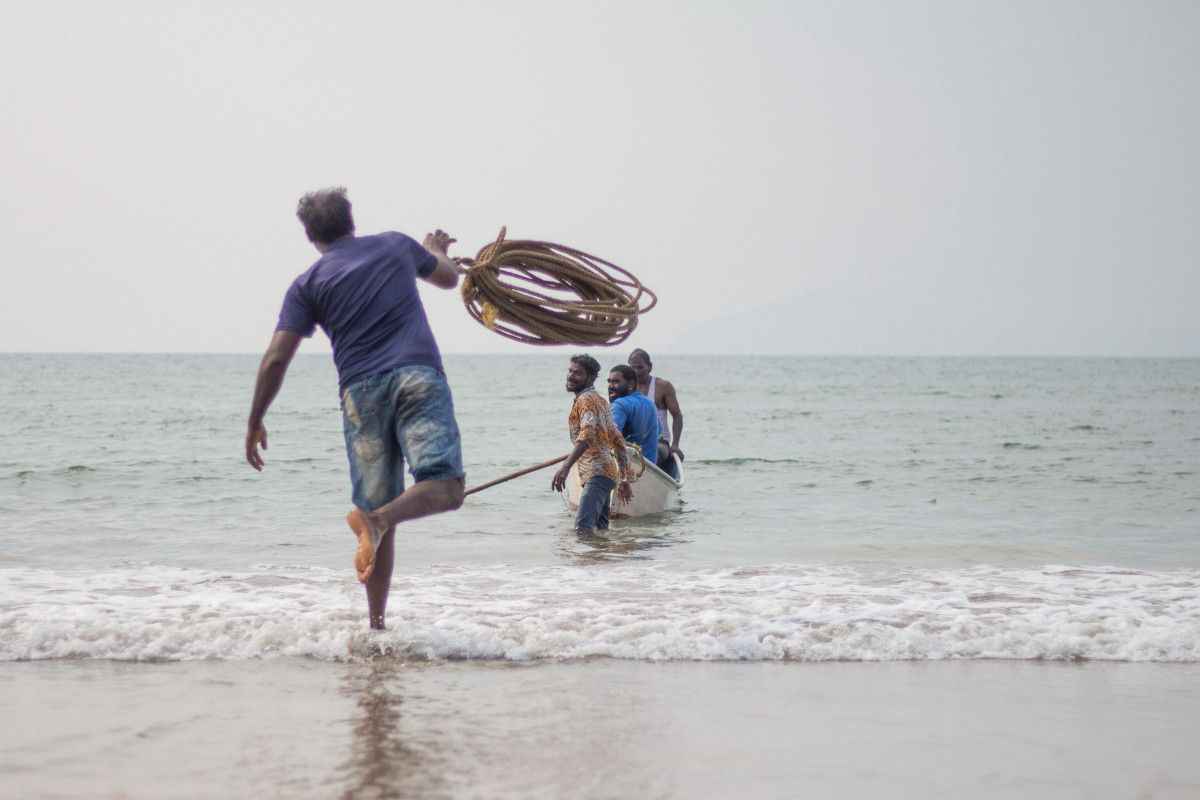
 In late February 2025, the district administration of Uttara Kannada made their way to Kasarkod Tonka, a village in the region, to conduct a land survey. This survey was for a road leading to the proposed Honnavar port in the region. Anticipating public resistance, the district magistrate imposed Section 163 of the BNSS a day prior to the land survey, which prohibited public gathering between 6 am and 9 pm. Despite this, hundreds of fishers marched on the streets and into the sea in defiance and frustration.
The locals were largely against the port that would displace them, fracture their livelihoods and irreversibly change the ecosystem they live in and protect. Fishers and activists from the region informed me that the natives of Kasakod Tonka had been putting together their land documents and asking for a land survey for a year prior, in order to prove that the land belongs to them. But when the authorities came for the land survey, they entered private residences without prior consent and began measuring them for the road, a flagrant move further prompting the people of Uttara Kannada to protest.
In response to their peaceful protests, news reports and eyewitness videos show that the police, district administration and rapid action force (RAF) personnel unleashed violence, dragging and assaulting villagers and allegedly filing false cases against them. Less brutal but similar stories unfolded in Keni, and other parts of Uttara Kannada where the State responded to peaceful protests against proposed infrastructure projects with police supervision and banning fishers from the sea.Around the same time, hundreds of kilometres south, an important meeting was held at Vikas Sabha in Bengaluru.
Chaired by Karnataka fisheries and ports minister Mankal S. Vaidhya of the ruling Congress party, the gathering was a pre-budget meeting for the financial year of 2025-26. A prominent and oft-emphasised theme of this meeting was the Sagarmala programme – the NDA Government’s flagship initiative to transition India into a port and coastal infrastructure based economy. In the meeting, Jayaram Raipura, the CEO of Karnataka Maritime Board, emphasised the state’s commitment to Sagarmala projects and ensuring that their completion is sped up. Raipura also requested for additional funds from Vaidhya – above the almost Rs 180 crore budget allocated by the state for Sagarmala for 2025-26 – to expedite projects under the Sagarmala programme, including the proposed road in Uttara Kannada’s Kasarkod Tonka.A state minister vehemently pushing for a Central project might seem confusing but looking at the Honnavar Port as an example paints a clearer picture.
The proposed Honnavar port is a public-private partnership between KMB and Honnavar Port Pvt Ltd (HPPL) – a consortium of two private infrastructure companies. However, the road for which the survey was conducted is a Sagarmala project. And this pattern is not one-off.
New policies, same patterns of discrimination?
As of today, there are 15 development projects planned across Uttara Kannada. These include eight ports planned along its 150-km coastline, a pumped storage project in the thick of the Western Ghats, a couple of railway lines and the expansion of a nuclear power plant. Uttara Kannada is also home to over 14 lakh people and nearly 50% of Karnataka’s fishers.
Of these 15 development projects, 14 belong to Karnataka Maritime Board while one is a Sagarmala Project. But this distinction holds little value when the nature of both KMB and Sagarmala are so intertwined.
To begin with, the cooperation between KMB and the Centre is by design. On their websites, press notes and all public facing communication, the need for cooperation from state maritime boards, state governments and other stakeholders is emphasised repeatedly. All but two newsletters released by KMB mention Raipura, urging the state to prioritise Sagarmala. None of this is illegal or abnormal in a federal government. But things get murky when corporate interests get involved.
On February 5, 2025, the Karnataka government unveiled a new Public Private Partnership Policy (PPP Policy) which opened 109 sectors for private investment, including energy, ports and transport. This policy states that the government will facilitate obtaining all project related risk clearances, including environmental clearances.
Fragmented accountability, numerous legal battles.
The problems with the PPP Policy have already begun to show. “In the Environment Impact Assessment (EIA) Report of Honnavar port, Kasargod and Keni villages are completely removed. They have also downplayed the number of people in Bhavikeri,” said Sreeja Chakraborty, environmental lawyer and founder of Living Earth Foundation (LEAF).
And harming the very same ecosystems and people is this nexus between KMB, Sagarmala and private players – primarily Jindal South West (JSW) and HPPL. While displacement and land use change are written into these infrastructure projects, the way these projects operate makes it harder for the people to fight against it legally.
Similar to Honnavar, the proposed port in Belekeri is a KMB Port. However, the Hubli-Ankola railway line – meant to transport iron ore and other cargo to the industrial hubs of Karnataka – is a Sagarmala project. Less than 10 km away from Belekeri is Keni where the proposed JSW-KMB port will dredge out the entire beach. While all these projects are within a geographical radius of 10 km, their legal fight and accountability is bifurcated between ports (Keni and Belekeri), policies (PPP Policy, Coastal Regulation Zone Notification, Karnataka Maritime Development Policy, Environment Impact Assessment Notification etc) and district/state/central/private authorities (District Administration, KMB, Karnataka State, Sagarmala, Fisheries Ministry, JSW, HPPL etc).
This split model of accountability and responsibility also fractures and further prolongs the legal battle against these projects. And as this bifurcated fight continues in courts, along the sea these projects continue to be built.
‘Development’ for whom?
While on one hand the people of Uttara Kannada have faced state violence and erasure from risk assessment documents, on the other they are dealing with a relatively new problem: being branded as anti-development.
“For the last few years, people in Uttara Kannada have been asking the government for a multispeciality hospital,” said Prakash Mesta, a marine ecologist who has been working in the region for decades. Back in 2013, Mesta, along with fellow scientists and researchers, wrote a technical report titled ‘Adopting Clustering Approaches – Ecology Integrated Sustainable Development of Uttara Kannada,’ which outlined a development model in Uttara Kannada that focused on sustainable tourism, apiculture and organic farming among other livelihoods. This model prioritises the people and resources of Uttara Kannada, keeping in mind the long-term ecological and social benefits of this model.
“The government has said there is no space for a multispeciality hospital. So how are they finding space for all these ports?” questions Meesta.
The model of development that the government is enforcing favours corporations, while disregarding the ecological and social realities of the region. “What we are seeing is a systematic colonisation of commons,” emphasises Chakraborty.
For the fishers in Karnataka, commons are as crucial as the sea. These commons – including mangroves, estuaries, fishing grounds and beaches – are the centre of fisheries-related livelihoods. Particularly for fisherwomen who use commons to dry and sell fish.
The natives of Uttara Kannada – its fishers, farmers, riverine and forest-dependent communities – have been the custodians of land and sea for generations. Right from protecting turtle landing sites and mangroves, to observing an annual fishing break in the monsoons for fish population to regenerate, they have been largely responsible for the unblemished coastal and estuarine ecosystems in the region.
In late November 2025, they convened for a district-wide roundtable to write to state and Union-level ministers, registering their strong opposition to the ongoing model of development in their region. The roundtable resulted in five core demands that the people have from their elected representatives. First, to halt all clearances and land acquisitions until proper impact assessments are conducted. Second, conduct an independent socio-economic evaluation of small-scale fisheries, estuarine resources and forest-based livelihoods Third, review the legality of existing project approvals. Fourth, restore and formally acknowledge traditional commons and fifth, reorient development priorities with people’s needs and wants. Under the umbrella of ‘Ondu Uttara Kannada’ (Unified Uttara Kannada), this citizen-led movement has put protecting their livelihoods, lands and water at the forefront of their resistance. While some district and state level ministers have attended people’s public hearings and listened to their objections, so far a change has not been reflected at a policy or legal level.
Is this ‘development’ feasible?
Last February, during the meeting chaired by Vaidhya, Raipura requested funds to be allocated to address a major, recurring problem, that does not care for legal battles, policy changes or loopholes: coastal rrosion. Karnataka’s coast is no exception to the insurmountable climate crises. Coastal erosion, illegal sand mining, biodiversity loss, soil and water pollution: all these issues and more plague the state’s almost 350-km long coastline.
A 2024 study by the government registers half of Karnataka’s coastline as unstable with high accretion and erosion rates. With a rapidly eroding coastline, staunchly resisting natives and growing ecological and social problems, the question begs: Is Sagarmala enabling a reckless model of development that will destroy Uttara Kannada?
This article was originally published in The Wire and you can read here.
