
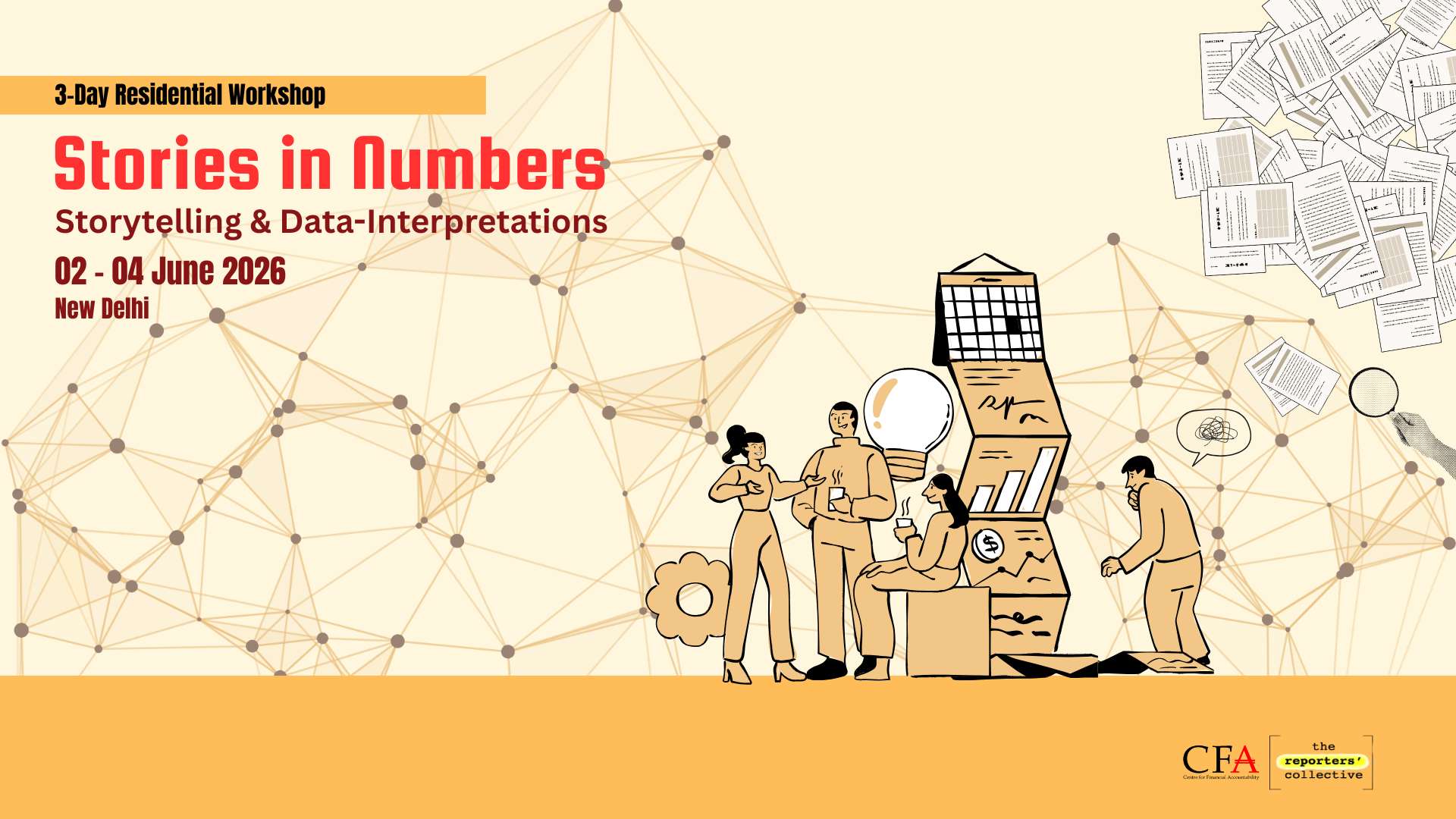
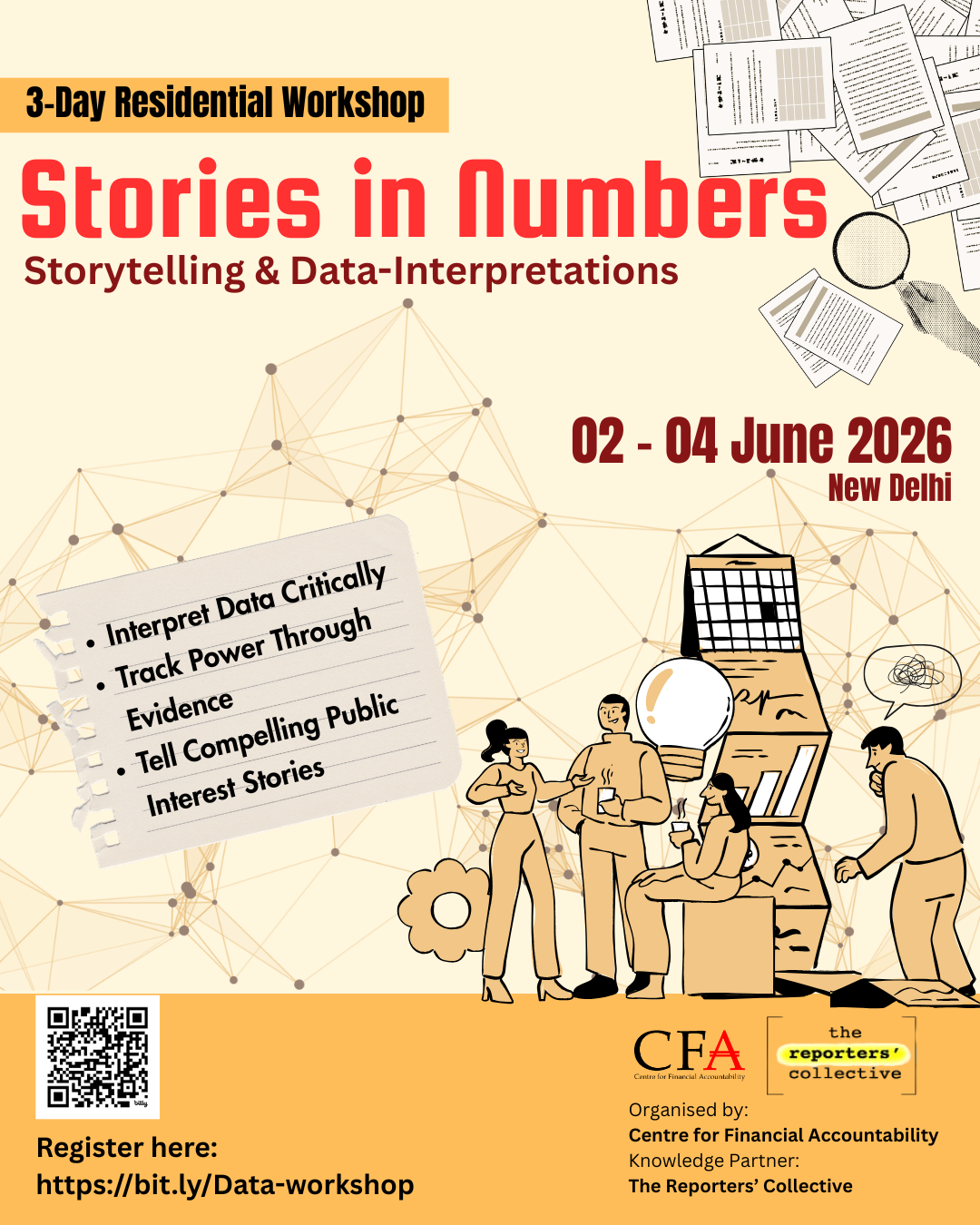
A three-day Residential Workshop
- Date: 02nd June to 04th June 2026
- Venue: USO House, USO Marg, 6, Special Institutional Area, New Delhi
 Data is a crucial tool for making sense of the world. It is crucial for reading the contours of the economy. It reveals the undercurrents of finance that often stay hidden in plain sight. But knowing how to read it, interrogate it, and turn it into a story that holds power accountable is a skill most of us are never formally taught.
Stories in Numbers is a three-day residential workshop designed to help with precisely that.
Over three intensive days, participants will work with investigative journalists, public finance specialists, and data practitioners to build hands-on fluency: reading government budgets and audit reports, tracking how public money moves (and disappears), navigating financial databases, and understanding the legal and editorial safeguards that make data journalism defensible. The programme moves from the foundations to the feel of it, using real datasets, not just hypotheticals. It will also try to unravel how data is often obfuscated, misinterpreted, and even withheld to bend the truth.
The workshop is designed for journalists, researchers, and civil society practitioners who work with data in some form but want to go deeper, into sharper analysis, stronger storytelling, and more accountable public interest work.
Objectives
The workshop aims to:
- Build participants’ ability to access and interpret public data sources.
- Develop skills to analyse financial and policy-related datasets.
- Enable participants to track the flow of money across government and private systems.
- Strengthen the ability to identify gaps between claims and reality.
- Equip participants to translate complex data into clear, compelling narratives.
Who Should Apply
- Media and communication professionals from NGOs and CSOs
- Members of people’s movements and grassroots organisations
- Community media practitioners
- Independent and freelance journalists
- Researchers and campaigners documenting field realities
What Participants Will Learn
- A practical understanding of how to read government budgets, going beyond headline numbers to track whether allocated funds reach intended schemes and communities
- The ability to interpret audit reports and government records, and identify gaps between what was promised and what was delivered
- Skills to navigate corporate records, understand basic accounting forensics, and identify red flags in private sector operations
- Familiarity with open data sources, including government databases and international financial institution (IFI) datasets
- Hands-on experience in cleaning and analysing datasets, including the use of pivot tables and basic data tools
- An understanding of how to choose appropriate visualisations to communicate data effectively to different audiences
- The ability to identify stories within datasets and public documents, and develop them into structured narratives
- Techniques to combine data with human stories, ensuring that evidence supports and strengthens the narrative
- A grounding in ethical and responsible storytelling, including accuracy, clarity, and accountability
The workshop is designed as a hands-on, practice-oriented learning space.
A Certificate of Completion will be provided to all participants who successfully attend the workshop.
Accommodation & Fees
Participants will be charged a nominal fee of ₹3000, which partially covers food and accommodation during the workshop.
✅ Accommodation and meals will be provided for selected participants.
❌ Travel costs will need to be borne by participants.
Shortlisted applicants will receive payment details via email.
Workshop Details
Format: Residential Workshop
Duration: 3 Days
Location: New Delhi
Primary Language: English
Participants are required to bring their own laptop for the workshop.
Concept Note Workshop Schedule
Application Closed.

Organised by: Centre for Financial Accountability | Knowledge Partner: The Reporters’ Collective
