
An Analysis of the Union Budget 2026-27
 Listening to the Finance Minister’s speech right after reading the Economic Survey felt as if the sound and fury of the Survey signified nothing. The Survey, sans several of the unqualified praise for the state of the economy, had rightly underlined the exigencies we are exposed to in the face of the global uncertainties and geopolitical realignments. The global churn it said is going to reshape things for years to come. And this, it said, shall require India to prioritise “domestic growth maximisation”. This was in line with the government’s own rhetoric of “Swadeshi” over the course of the last year in the face of the mounting tariffs.
But the alarm and urgency voiced in the Survey sadly did not reflect in the budget document. At least as far as boosting internal markets is concerned. The government had fired the ‘big guns’ to push consumption last year, one with the tax breaks for the middle class and two with the GST cuts. But the jury is out as to whether the impact on demand was to the extent it was anticipated. While automobiles and two wheelers did see some swell in sales, the FMCG companies barely saw much improvement in sales. The burden of alarming household debt, the alarmingly stagnant wages, precarious jobs and the consequent uncertainties meant that people remained cautious with their spending despite the big hoardings on “bachat utsav”.
Given the fall in exports in the midst of tariff wars and the constantly escalating global tensions, building domestic resilience by addressing some of the pressing concerns around income, debt and purchasing power was essential. Ideally one would have expected a major and programmatic intervention to structurally address the concerns around people’s shrinking pockets. But sadly the budget steered clear of any of these steps as is evident in the stagnating, if not shrinking, allocations to welfare and rights based schemes, health, education, social security and so on.
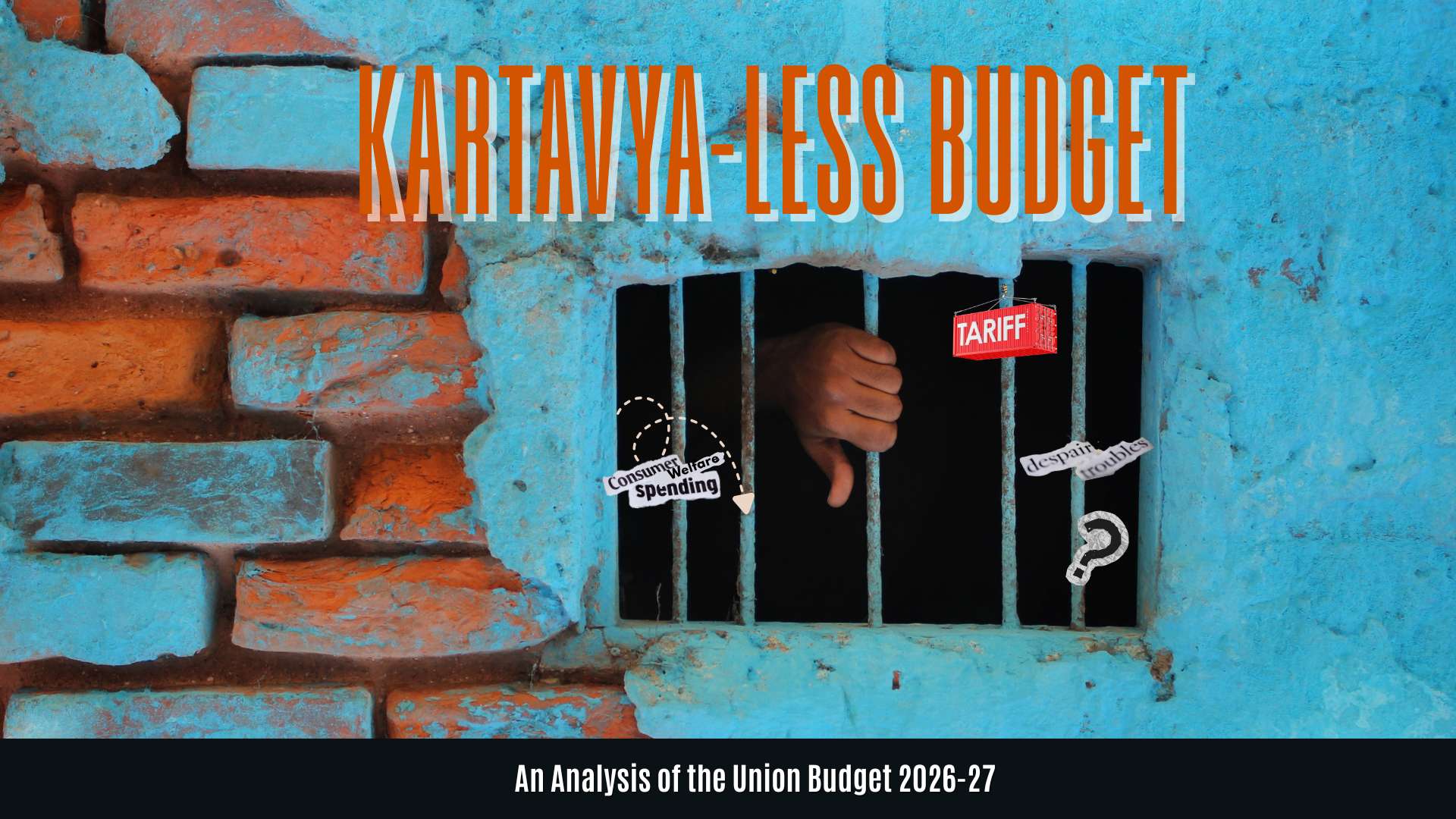
Instead, this year’s budget foregrounds the idea of kartavya. While the Finance Minister speaks of three kartavyas of the government, it is imperative that we interrogate what the government actually implies by the notion of kartavya. The use of this idea is not without substance. It draws from the ideological underpinnings of this regime that has over the course of the last decade, foregrounded the idea of “kartavya” (duty) of the citizens in lieu of the much derided idea of “adhikar” (or rights). In this scheme of things, welfare was no longer rights-based entitlements, but “gifts” from above on the disbursal of which the government had discretionary powers. Hence the discourse of “laabharthis” (or beneficiaries) that we have been made familiar with. The most recent step in this direction was the dismantling of MGNREGA as a justiciable right to work, replaced with the discretionary VBGRAMG.
The idea being communicated in the budget in fact is that people ought not to expect any immediate relief or support, and in fact it is their duty to endure in these troubled times. On this count in fact there is a lot of congruence with the tone of the Economic Survey which underlined that we ought not to look for “fleeting comfort” (preya) and rather opt for “enduring good” (sreya). That the people of the country should not look for “quick fixes to visible, short-term pressures”, but rather suffer dutifully.
And what is the kartavya of the government? It is to simplify the “baggage clearance” during international travel for the super rich; to further cut corporate taxes by reducing MAT rates; to offer cheaper foreign tour packages; to reduce costs for personal use imported items!
