
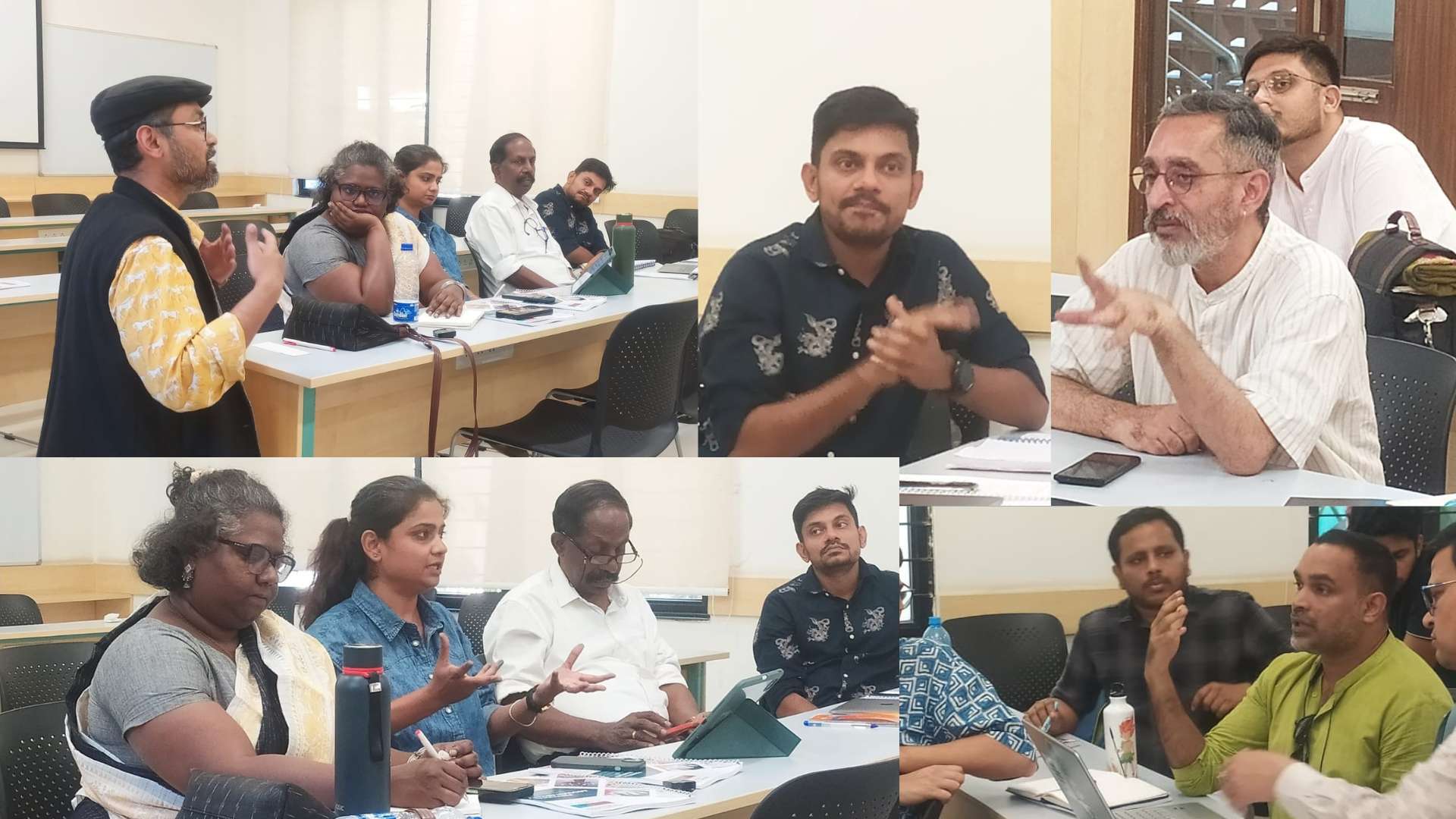
The round table on “Financial Accountability: Reclaiming Oversight of Credit and Ethical Investment” and the subsequent workshop on pathways towards transparency of project investments” were organised by the Centre for Financial Accountability (CFA) as part of the two-day consultation titled “Strengthening Accountability Systems: Reflections, Innovations & Collective Action” hosted by the Theory and Practice of Social Accountability Project at the National Law School of India University (NLSIU), Bangalore, on February 14–15, 2026. The session brought together practitioners, researchers, trade union representatives, activists, and media professionals to discuss how financial institutions can be made more accountable to society, both in terms of credit practices and investment decisions.
The discussion began with the premise that accountability must be ensured at multiple levels—financial, environmental, and political. Participants emphasised that banks and financial institutions operate primarily with public money, including household deposits and taxpayer-funded recapitalisation. This gives rise to a fundamental democratic principle: “Hamara paisa, hamara hisaab” (our money, our accountability). If public resources sustain the banking system, then the public must have a legitimate stake in knowing how that money is deployed and what social and ecological consequences it produces.
Participants reflected on the changing nature of the Indian banking system over recent decades. Several concerns were raised about the weakening of socially embedded banking practices, including declining rural branch presence, dilution of priority sector norms, and stagnating staffing levels in public sector banks. At the same time, the financial system has increasingly shifted its focus toward large corporate borrowers and financial markets, while small borrowers—particularly farmers, workers, and informal sector participants—often face expensive or exploitative credit arrangements through intermediaries such as NBFCs. This shift has significant implications for inequality and financial distress, particularly in the context of rising household indebtedness.
The conversation also highlighted the concentration of economic power and the emergence of large corporate monopolies across sectors. Participants noted that a relatively small group of corporations now dominate key industries, and financial flows often reinforce this concentration. One suggestion was to develop mechanisms for collective monitoring of major corporate groups across their different sectors of operation. Such monitoring could help civil society track how finance enables certain development trajectories and assess the broader impacts on communities and ecosystems.
Another important theme was the need to expand the scope of financial accountability beyond banking institutions alone. While much civil society work—including that of CFA—has focused on banking capital, participants pointed out the growing influence of private capital markets and financial intermediaries. This requires greater attention to regulatory bodies such as the Securities and Exchange Board of India (SEBI) and the Insurance Regulatory and Development Authority of India (IRDAI), which play a crucial role in overseeing capital flows, investment instruments, and financial market conduct.
The workshop that followed focused specifically on transparency in project-level investments. Participants argued that meaningful public oversight is impossible without a more comprehensive disclosure regime. At present, information about loans and investments in large projects is often withheld on grounds of confidentiality or commercial sensitivity, despite the fact that such projects can have profound environmental, labour, and climate impacts. A stronger disclosure framework—especially project-specific transparency—was identified as a necessary step for enabling affected communities, researchers, and citizens to assess the risks embedded in financial flows.
Participants also emphasised the need to critically examine the growing discourse around “green finance.” While financial institutions increasingly claim to support environmentally responsible investments, there is limited scrutiny of whether such investments genuinely address environmental and social concerns. Monitoring green finance from environmental, climate, and social accountability perspectives was therefore seen as an important area for future work.
Finally, the session underscored the importance of building collective platforms for sustained engagement on financial accountability. Several participants suggested the creation of a broader forum on finance that could bring together civil society groups, labour unions, environmental movements, and researchers. Such a forum could help coordinate research, advocacy, and public engagement around the financial system.
The discussion concluded with a shared recognition that transparency and accountability regimes are only as effective as the collective efforts that sustain them. Strengthening financial accountability will therefore require continued collaboration, public scrutiny, and coordinated action across sectors.
