
Online discussion
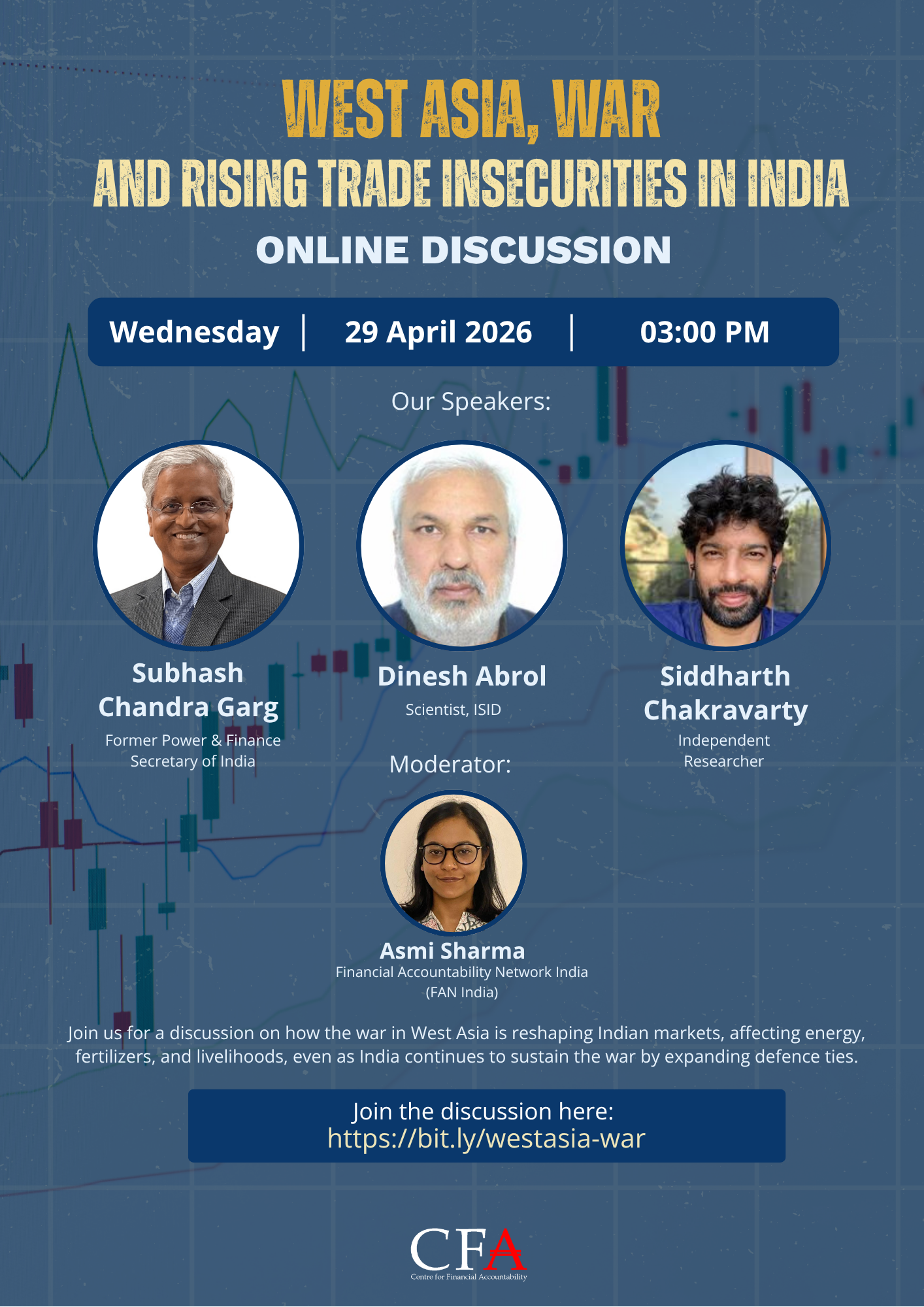 Date: 29th April 2026
Time: 3 p.m.
Speakers:
Subhash Chandra Garg – Former Finance and Power Secretary, speaking on the implications for the energy Sector
Dinesh Abrol – Scientist, ISID, speaking on the impact on fertilizers and the agriculture sector
Siddharth Chakravarty– Independent Researcher, discussing defence sector ties and the role of energy as an oppressive tool
Moderator:
Asmi Sharma – Financial Accountability Network India (FAN India)
Join via Zoom:
https://us06web.zoom.us/j/89645356604?pwd=K5so4fukaborHuF0BMJbrXXq8CKGFZ.1
Meeting ID: 896 4535 6604
Password: 697689
Concept Note:
The recent US-Israel attack on Iran and the subsequent closure of the Strait of Hormuz have intensified global and national anxieties around trade, particularly related to energy and fertilizer flows, among others. For India, these developments are not distant disruptions but deeply embedded shocks transmitted through its structural dependence on imports, specifically oil, gas, fertilizers and defence equipment.
The Strait of Hormuz remains a critical chokepoint for global energy supplies, with a significant proportion of India’s crude oil imports passing through this route. With the fragile ceasefire in place, India’s heavy reliance on imported oil exposes the economy to volatile price shocks and has had immediate, visible implications for domestic fuel prices. This, in turn, burdens citizens through raising transportation costs, long queues for gas cylinders and broader inflationary pressures.
These effects are particularly acute in the agrarian context, where diesel and energy-intensive inputs can directly affect cultivation costs. The availability and prices of fertilizers reflect vulnerability, as Iran and the wider West Asian region play key roles in fertilizer production and exports. Disruptions in this supply chain may threaten food production systems. For Indian farmers, already navigating precarious margins, such shocks risk deepening agrarian distress.
Parallelly, India’s current expansion of military and strategic ties with Israel points towards urgent concerns beyond trade dependence. We have been witnessing how arms deals increasingly merge with the interests of a select few major private conglomerates and public sector units. Despite clear answers to who benefits from militarisation, more so when partnerships are marked by opacity, a higher degree of control, including broader systems of surveillance, the costs are borne by both the general public at home and inevitably by Palestinian populations. As contentious arms deals cannot be viewed as neutral instruments of security, their role in enabling and legitimizing sustained violence becomes clear.
The exhibition of India’s evolved and tightened friendship with Israel and the US marks a departure from its historical positioning within the Global South. This public friendship, coupled with rising domestic vulnerabilities, raises critical questions about who ultimately bears the cost of our geopolitical positioning. India’s alignment with the US-Israel instead of its forgotten ties with countries like Iran, with whom trade in energy, oil, gas and fertilizers enables domestic stability, demands urgent attention. This webinar, therefore, aims to assess how deepening external dependencies and strategic alignments invite domestic consequences, whether microscopic or massive.
In this context, to develop a better understanding about the implications of war on trade, the Centre for Financial Accountability is holding a webinar. This webinar seeks to critically examine how external conflicts translate into material consequences at home. The audience will be members of civil society organisations, researchers and the general public.
