
The real test for Budget 2026 is not just what headline “job stimulus” the government announces, but whether it actually raises the quality of work.
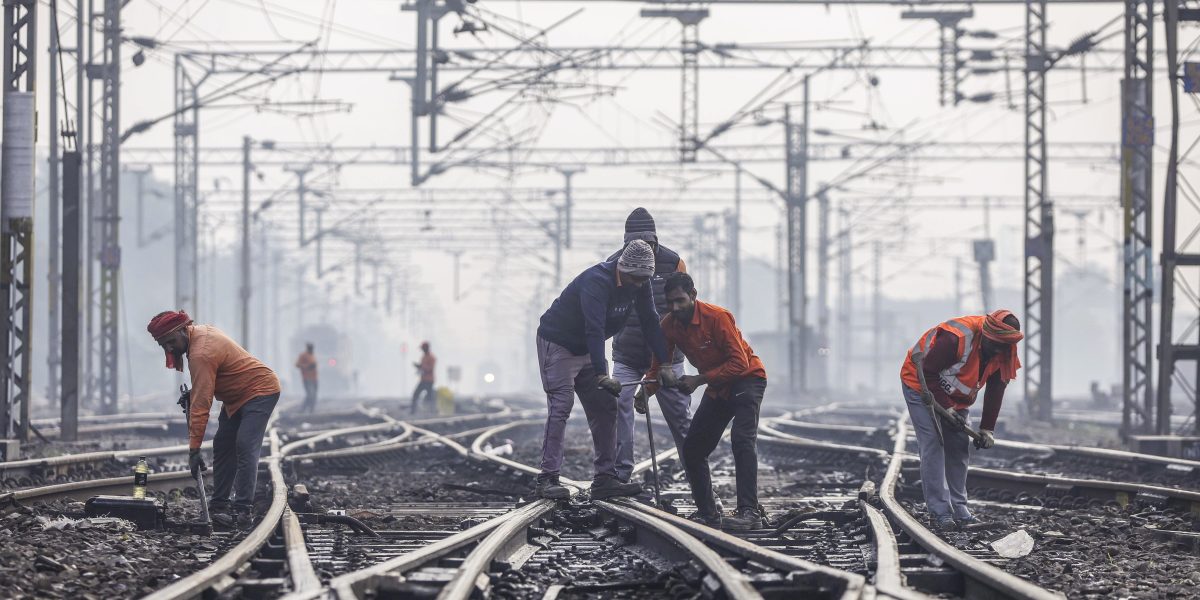
Workers mend railway tracks, ahead of the presentation of the Union Budget 2026-27 by Union Finance Minister Nirmala Sitharaman, in Prayagraj, Saturday, Jan. 31, 2026. Photo: PTI.
When the Bharatiya Janata Party took office in 2014, it pledged to generate two crore jobs annually. At this rate, the government should have created over 20 crore jobs. While the government claims that more people are entering into the workforce, the reality remains that many of these workers are engaging in low-wage, low-quality and insecure work. Even as GDP rises and India becomes the world’s fourth largest economy, this has not translated into any improvement in the nature of employment. India is seeing a reversal of structural transformation, i.e, the trajectory of a growing economy should be visible in the changing nature of employment with workers moving out of agriculture into more formalised jobs in the manufacturing and services sector. Instead, especially in the post-pandemic period, employment is shifting back into agriculture, compounded with the growth of informal and precarious employment. In this context, how successful has the government actually been in its claim of increasing employment across sectors? What do the post-pandemic Union Budgets tell us about job creation and the quality of jobs being created, and how do these claims measure against outcomes?
Failing to create manufacturing jobs
Coming into power in 2014, the Make in India scheme was launched by the government, presented as the route to boosting the manufacturing sector and consequently leading to job creation. The programme aimed to double the growth rate of the manufacturing sector, increase the sector’s share of GDP to 25% and create 10 crore jobs. However, by 2023, when the flagship programme entered its tenth year, not a single target of the scheme had been achieved. Over the past decade, India’s manufacturing output has remained largely stagnant, averaging between 15-17% of GDP. As per the latest Annual Survey of Industries and the Annual Survey of Unincorporated Sector Enterprises, employment in manufacturing stands at about 1.85 crorein the formal sector and around 3.5 crore in the unorganised sector.
Following the pandemic, in November 2020, the Production Incentive Scheme was announced to enhance the country’s manufacturing capabilities, with the total outlay of Rs 1.97 lakh crore. The scheme was lapsed in early 2025 due to its inability to generate any major success except in a few sectors. Despite a US $ 26 billion outlay across 14 sectors, by October 2024 the scheme delivered only 37% of its production targets, less than 50% of the investments committed, and around 7% of allocated subsidies disbursed.
The impact of stagnant manufacturing can be felt on employment. After reaching its peak employment at 12.6% in 2011-12, there has only been a steady decline in jobs in the manufacturing sector, with slow recovery in the post-pandemic period. The ILO’s India Employment Report 2024 has described India’s structural transformation as ‘stunted’.
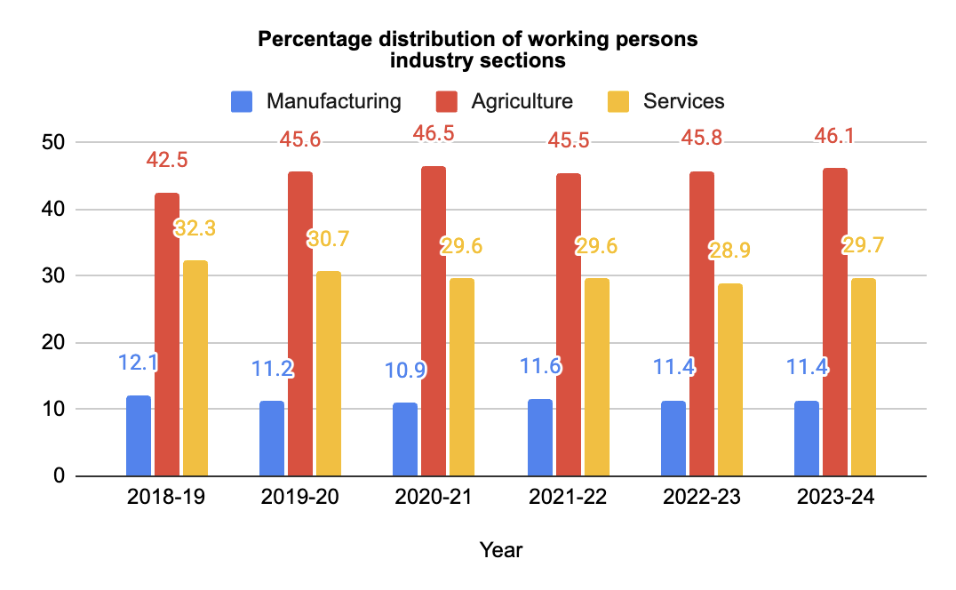
Periodic Labour Force Survey 2018-19 to 2023-24
MSMEs suffering, employment in decline
A large part of the Government’s employment agenda rests on the MSME sector. Yet, successive policy decisions like demonetisation and the implementation of GST, and the sector’s vulnerability to economic shocks such COVID-19 and now the US tariffs, have seriously hurt MSMEs, leading to establishment closures and, in turn, job loss. Between 2021-22 and 2024-25, close to 79,000 MSMEs shut down, with the number of MSMEs shutting rising year on year. MSMEs’ share in India’s total Gross Value Added has remained nearly unchanged since 2014at approximately 29.6%, despite the narrative that MSMEs are the economy’s growth and jobs engine.
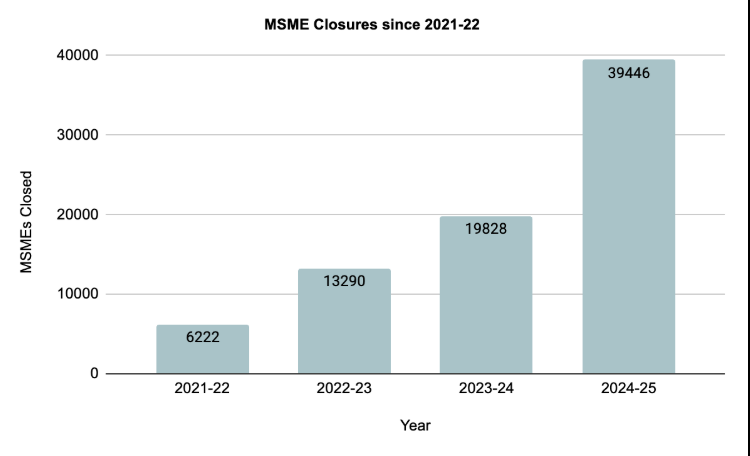
Lok Sabha & Rajya Sabha Unstarred Questions
With access to credit being a key method for support to the sector, there are issues even with these. The Prime Minister Employment Generation Programme is one such key central sector, demand driven scheme, that has since 2019-20 has seen budget allocations made to the programme always be less than the revised estimates and actuals. Additionally, the number of enterprises assisted and employment generated through the scheme have sharply declined since 2021-22.
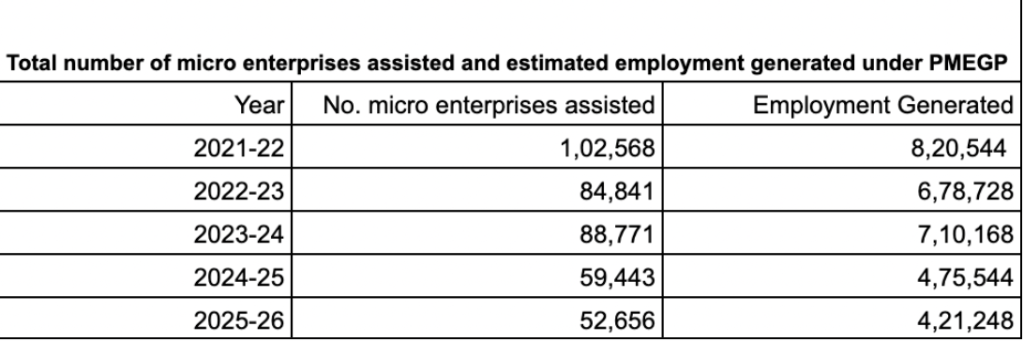
Lok Sabha Unstarred Question No. 1906
The Pradhan Mantri Mudra Yojana (PMMY), a flagship scheme of the Government to boost entrepreneurship finds that the bulk of loan accounts between FY 2020-21 and FY 2024-25 were in the ‘Shishu’ category (loan size below Rs 50,000). Of the roughly 28.83 crore loan accounts over this period, about 67% are Shishu loans. The high volume of low ticket loans points to limited credit support, which does not necessarily support the long-term sustenance of enterprises.

Lok Sabha Unstarred Question No. 2323
Agriculture and rural economy ignored
The PLFS 2023-24 finds that 46.1% of India’s population still depends on agriculture and allied activities for its livelihood but accounts for only 16% of GDP, underlining how a large share of workers continue to remain concentrated in low income and low productivity jobs.
Simultaneously, the key scheme for rural job creation, MGNREGA, has faced successive budget cuts and chronic underfunding despite clear evidence for the demand for work. Of the budget allocated each year, close to 20% is used to clear dues from the previous year, further reducing the budget for employment generation.
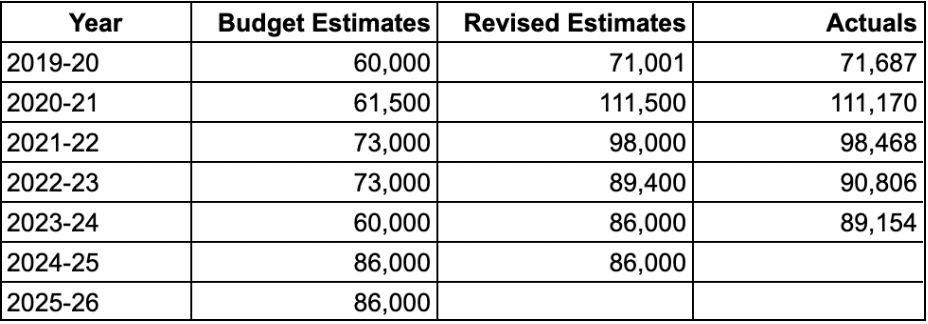
MGNREGA Budget 2019-20 to 2025-26
The ESI 2025-26 states that MGNREGA has hit its structural limits and needs reassessment since lesser households have demanded a full 100 days of work post-pandemic, but economists and activists have repeatedly argued that this does not show reduced demand for employment but rather the suppression of demand through budgetary constraints. In 2023, NREGA Sangharsh Morcha estimated that to meet 100 days of employment for registered households, the MGNREGA budget would need to be increased to over Rs 2 lakh crore. The newly passed VB GRAM G Act is likely to further constrain rural job generation by shifting financial responsibility onto states, it limits their ability to provide work.
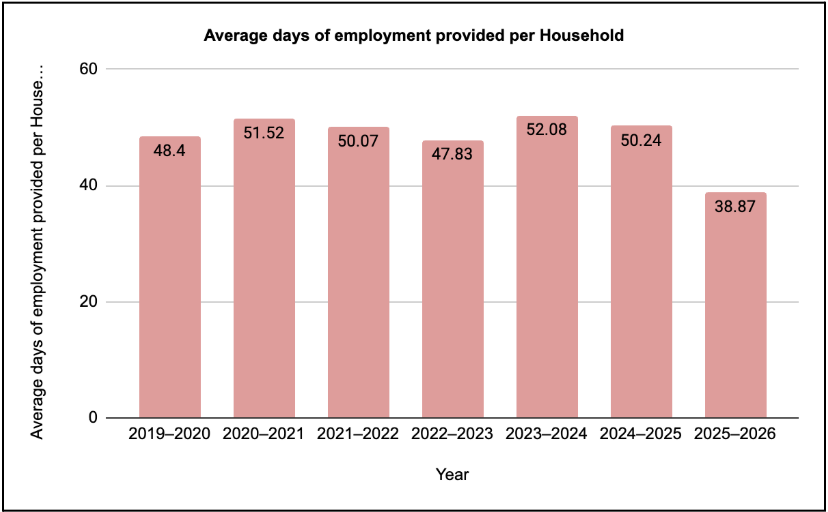
MGNREGA MIS
Unorganised sector workers
India is facing a quality of jobs crisis, with gig, informal and unorganised sector work increasing, especially in the post-pandemic period. The question is not only whether employment is increasing, but what kind of employment is being created. Therefore, the availability of social and economic protections becomes central to any discussion on job creation.
Even as employment becomes more informal and precarious, public spending is being channelled increasingly into schemes anchored in the formal and contractual, EPFO-linked ecosystem rather than into welfare measures for unorganised sector workers. For example, the Ministry of Labour and Employment has steadily increased budgetary support for the Employees’ Pension Scheme (EPS), 1995, increased from Rs 4,500 crore in 2019 to Rs 11,250 crore in the present Budget, accounting for one third of the Ministry’s total outlay. At the same time, allocations across welfare schemes for social protection, food security, health, and education are steadily decreasing.
The newly notified Labour Codes send a clear message about the government’s approach to work and employment, where market is prioritised over the worker. The real test for Budget 2026 is not just what headline “job stimulus” the government announces, but whether it actually raises the quality of work, by strengthening job security, expanding social protection, and ensuring basic safeguards for workers across sectors.
This article was originally published in The Wire and you can read here.
