
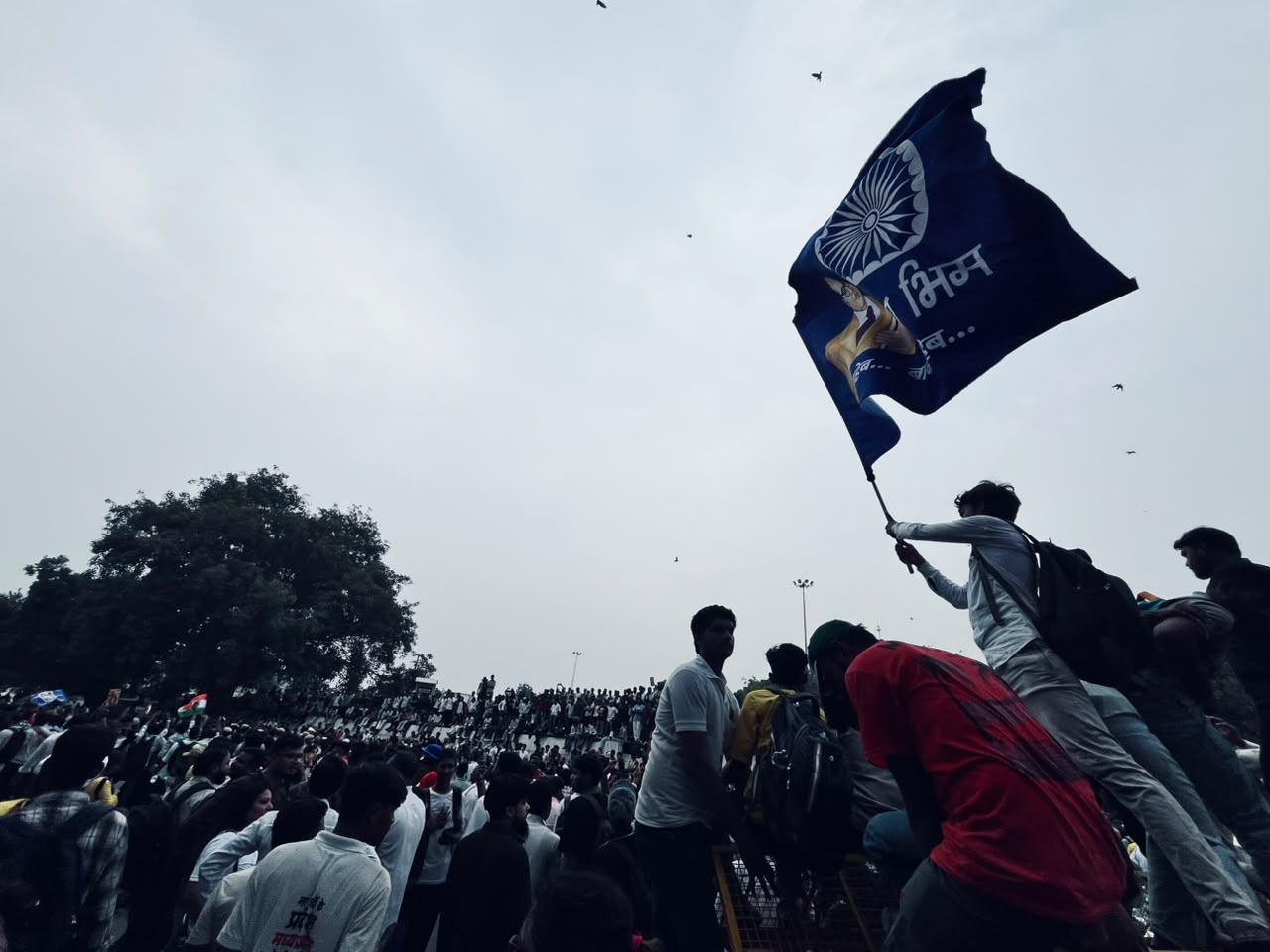
Image credits: Arjun Unnikrishnan/Centre for Financial Accountability (CFA)- Student protest, Jantar Mantar.
Dharmendra Pradhan resigned as Union Education Minister on July 25, ending 36 days of protests led by the Cockroach Janta Party, All India Students Association (AISA) and other student organisations after the NEET-UG papers held on May 3 and May 7 were leaked and cancelled, forcing a re-exam on June 21 and a CBI probe. Nearly two million students had sat for the exam; the fallout included a wave of student suicides linked to the cancellation, and the opposition has counted over a hundred such leaks in the past decade with almost no senior official ever held accountable. Most media coverage will treat this as a political story, or at best an academic one, a minister’s exit, a broken exam system. What keeps getting left out is the financial trail: who’s paid, who profits, and who’s actually held accountable for the money.
The budget headline hides the real story. India’s Union Budget 2026 allocates just under ₹1,39,289 crore to education overall, an 8.27% increase over last year. Of that, the Department of Higher Education got ₹55,727 crore, up 11%. Those numbers sound like a system flush with funds, until you place them against the yardstick the government set for itself: NEP 2020 called for education spending to reach 6% of GDP, and this budget doesn’t come close. Even measured against the OECD average of near 5% of GDP, India’s allocation reflects sustained underinvestment, not a funding surge. And within that undersized pie, most of the higher-education money goes to IITs, central universities, and UGC, institution-building, not the exam-delivery machinery that just failed two million students. The National Testing Agency, the body that actually conducts NEET, JEE and dozens of other exams, doesn’t draw from this pool at all. It’s designed to be self-funded.
That’s the part that should worry us. NTA runs almost entirely on the fees it charges applicants. Between 2018-19 and 2023-24, it collected ₹3,512.98 crore in application fees while spending ₹3,064.77 crore, 87.2%, on conducting exams, leaving a surplus of ₹448.21 crore, according to the education ministry’s reply to a question raised by Congress MP Vivek K Tankha in the Rajya Sabha. That income has climbed fast: fee collections jumped 78% in a single year, from ₹490 crore to ₹873 crore, after CUET was added to NTA’s charge in 2022-23 and over a million students began sitting for it annually. A JEE Main form costs around ₹1,700 with GST, NEET pricing sits in the same range, and CUET fees stack up further for students paying per subject. Even the 2026 NEET-UG cancellation carried a price tag, with over 2.275 million students registered, NTA is estimated to have collected ₹340-355 crore for an exam that never counted, refunded in full but with no accounting for what families spent getting there. In other words: an aspirant pays to be tested by an agency whose entire existence depends on the volume of aspirants paying, and whose income keeps climbing as its exam portfolio widens. There’s a structural tension worth naming here, a public gatekeeping function funded like a business, sitting on a profit margin measured in hundreds of crores of student money, built from a one-time ₹25 crore government grant it has never needed to draw on again.
The exam fee is the smallest number in this story. Students don’t just pay NTA, they pay into an entire parallel economy built around getting into a position to take the exam. India’s private coaching industry is now estimated at ₹58,000-60,000 crore, more than the entire higher education budget for the year, and it has grown large enough to draw its own GST scrutiny: the Centre’s GST collection from coaching centres climbed from ₹2,240.73 crore in 2019-20 to ₹5,517.45 crore in 2023-24, a nearly 150% jump in five years, according to data placed before the Rajya Sabha. Coaching hubs like Kota, Sikar, Delhi, Patna and Guwahati run on classroom fees of ₹1-2.5 lakh a year, hostel rent of ₹40,000-80,000 annually, and test series and material on top, a package that can start at ₹60,000 and balloon past ₹1.2 lakh once everything is added in. This is money leaving households already under pressure from stagnant incomes and rising debt, often borrowed or raised by selling land and jewellery, spent on the promise of a fair shot at a medical seat. When an exam gets cancelled or re-run, none of that spending is recoverable, and coaching institutes themselves often refuse pro-rata refunds even when a student drops out, with the National Consumer Helpline logging over 16,000 complaints against coaching centres in a single year, most of them about exactly this. No one, not NTA, not the coaching industry, not the ministry, is accountable for any of it.
And where does that fee income actually get spent? Not on staff, and not transparently either. NTA has roughly 25 permanent employees running exams for the entire country. In a December 2024 reply to Parliament, the Ministry of Education put the full staffing picture at 198 people, 22 on deputation, 38 contractual, and 138 outsourced, meaning over 170 non-permanent hands touch an agency the government itself calls responsible for exam integrity. The actual legwork, booking venues, installing computers, hiring invigilators, arranging security, is handed to private vendors because the agency has nowhere near the staff to do it directly, and those vendors are for-profit businesses whose incentive runs exactly where you’d expect: toward the cheapest invigilator, the oldest computer, the security check that gets skipped to protect a margin. The Radhakrishnan Committee, formed after the 2024 leak, flagged this directly, sensitive work like question processing, translation and centre management sits with contractual staff rather than accountable officials inside the agency. Yet when an RTI was filed asking what NTA actually spends on salaries and what its top officials earn, the agency refused, arguing in a June 2026 reply that compiling the figures would amount to “generating” new information, not something the RTI Act requires it to do. NTA has also ignored a parliamentary panel’s repeated request, first made in March 2025, for it to publish an annual report; its finances don’t appear in CAG audits at all. So the leak wasn’t a glitch. It was a predictable output of the funding model: public money built the exam’s legitimacy, the NEET degree, the IIT seat, the government job that follows, but the exam’s delivery was outsourced down a chain of contractors paid out of student fees, with no budget line, no parliamentary scrutiny, and until this week, no ministerial consequence. Pradhan’s resignation closes a political chapter. It changes nothing about how the next exam gets built, staffed, or secured.
Centre for Financial Accountability is now on Telegram and WhatsApp. Click here to join our Telegram channel and click here to join our WhatsApp channeland stay tuned to the latest updates and insights on the economy and finance.
