
The finance ministry needs to acknowledge that relying on NBFC-led credit delivery while banks retreat from small-ticket lending is neither equitable nor sustainable.
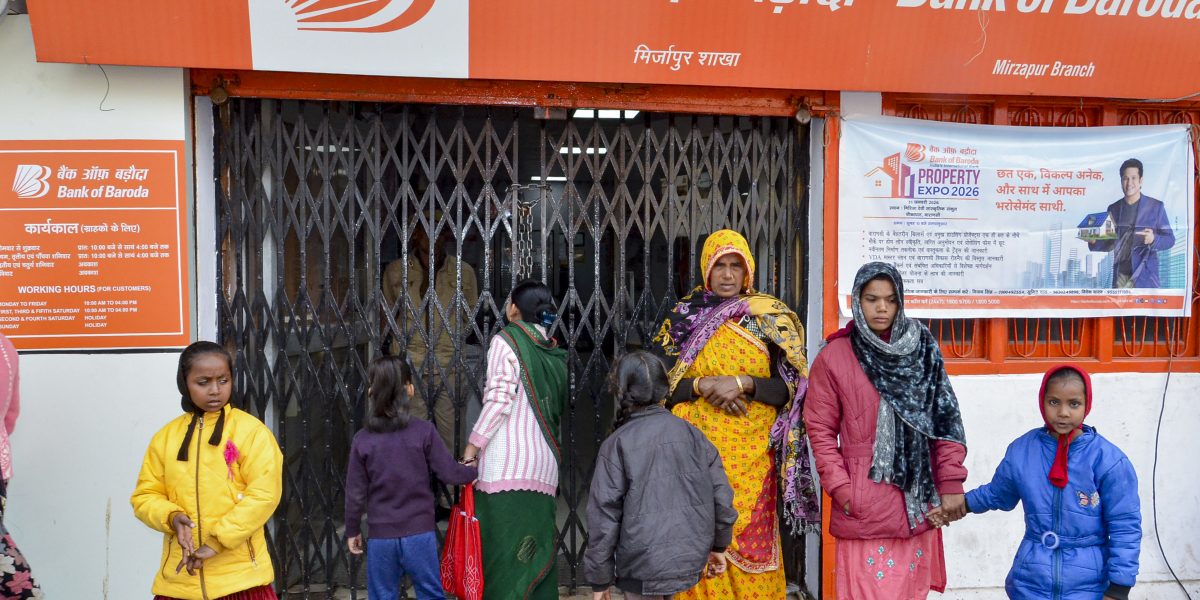
People gather outside a branch of Bank of Baroda as it remains closed in Mirzapur on January 27, 2026. Photo: PTI | The Wire
For several years now, India’s Union budgets have relied more on rhetoric than on genuine economic course correction. Too often, budgetary announcements appear disconnected from the Economic Survey presented just days earlier by the chief economic advisor. This growing dissonance raises a fundamental question: are policy signals being translated into fiscal action, or are they merely acknowledged and set aside?
A useful contrast can be found closer home. In recent years, Tamil Nadu’s state budgets – most notably the one themed “Growth for All; Everything for Everyone” – have demonstrated that inclusive growth need not remain a slogan. Fiscal priorities, expenditure patterns, and outcomes were visibly aligned. The Union Budget would do well to internalise this approach.
Warnings ignored in the Economic Survey
The Economic Survey 2026, while generous in its praise of the government’s macroeconomic management, nonetheless flags several areas of concern. It recognises that FY27 will be a period of adjustment, marked by uncertainty in the global environment, volatile capital flows, tariff-related disruptions, and slowing growth in key trading partners. These are not abstract risks. They directly affect exports, investment sentiment, and employment.
Yet the Survey stops short of outlining how these risks should be addressed through fiscal policy. That responsibility rests squarely with the Finance Minister. The credibility of the Union Budget depends on whether it responds concretely to these warnings – by strengthening buffers, supporting domestic demand, and reinforcing policy credibility – rather than merely reiterating optimism.
One of the more striking contradictions in recent policy discourse concerns public sector enterprises. Over the last five years, the number of operating Central Public Sector Enterprises (CPSEs) has increased, their total Gross Turnover of CPSEs in last five years increased from 24.62 to 37.01 lakh crore. Net profit increased from 0.93 to 2.91 lakh crore and dividend increased from 0.72 to 1.39 lakh crore.
These figures suggest improved efficiency and financial viability. If public enterprises are performing, contributing to revenues, and stabilising key sectors, the argument for reducing the state’s role weakens considerably. The Budget should clarify whether ideology is being prioritised over evidence.
The Survey also draws attention to structural vulnerabilities in the global financial system, including excessive risk-taking by Non Banking Financial Institutions (NBFCs). This is especially relevant for India, where NBFCs and micro-finance institutions (MFIs) have become dominant lenders to small borrowers. Over half of small-borrower loans now originate from NBFCs and NBFC-MFIs, while banks account for barely a third. These borrowers often face higher interest rates, aggressive recovery practices, and limited regulatory protection.
Despite repeated episodes of over-lending, borrower over-indebtedness, and rising non-performing assets, credit expansion in this segment continues largely unchecked. The microfinance sector’s original social mandate (i.e. household resilience, income stability, and asset creation) has gradually been overshadowed by growth-oriented, market-driven incentives. Outreach metrics such as number of borrowers or loan volumes are increasingly mistaken for impact, even though they reveal little about borrower welfare.
Without tracking indicators such as debt-to-income ratios, asset accumulation, or distress borrowing, credit growth simply risks deepening vulnerability rather than alleviating it. The Union Budget must confront this reality instead of simply celebrating the proliferation of NBFCs in the name of “financial inclusion”. The finance ministry needs to acknowledge that relying on NBFC-led credit delivery while banks retreat from small-ticket lending is neither equitable nor sustainable. The survey’s ambition of converting India into an “entrepreneurial state” will be impossible without cheap credit and support for equity capital.
Another concern highlighted in recent analysis is the vulnerability of mid-sized firms. Unlike large firms, they lack deep internal buffers; unlike small firms, they lack agility. Uncertainty shocks disproportionately affect them, depressing investment and capital formation. This has serious implications for employment generation and industrial growth, yet it receives little focused policy attention.
Then again, the claims in the survey around the Pradhan Mantri Mudra Yojana also warrant scrutiny. When cumulative loan accounts exceed the number of households in the country by a wide margin, it suggests recycling and renewal of loans rather than genuine financial inclusion. Inflated figures may serve political narratives but weaken policy credibility.
Banking reforms: A risky direction
Recent statements and consultations, including those emerging from the PSB Manthan, indicate a renewed push to dilute government ownership in public sector banks, grant greater autonomy to boards, and leave regulation primarily to the RBI. Proposals to sell government stakes in banks such as IDBI to foreign investors and to pursue further mergers among public sector banks are deeply troubling.
There have been statements on further merger of Public Sector Banks which may be announced in the budget. This again is going to be detrimental for the majority of small depositors and small borrowers. Public sector banks safeguard household savings and provide credit to agriculture, MSMEs, and vulnerable sections. Consolidation and privatisation risk marginalising small depositors and borrowers while concentrating financial power. The complete opening of the insurance sector to foreign ownership further amplifies these concerns.
What the budget must be judged on
Several key areas demand close monitoring in Budget 2026–27. These include:
- The actual performance of targeted agricultural schemes and the stagnation in Kisan Credit Card growth despite widespread agrarian dependence.
- Access to affordable credit for MSMEs, which increasingly rely on high-cost NBFC financing.
- The continued use of non-monetary provisions in money bills, a constitutional issue still pending judicial resolution.
A credible alternative exists. It requires expanding public banking capacity rather than shrinking it – by transforming post offices into universal bank branches, strengthening regional rural and cooperative banks, increasing public sector bank staffing, and restoring the role of development finance institutions for long-term lending. This would be a path where regulation of NBFCs and MFIs must be strengthened, insolvency mechanisms must be revisited in light of poor recovery outcomes, and urban livelihood missions revived to address rising urban distress.
Measures such as targeted farm loan relief, followed by fresh institutional credit, can revitalise rural demand and employment. No amount of free trade agreements can be a substitute for strengthening internal markets for which the banks must play a role in redistribution, credit support and investment.
Finally, the Union Budget cannot afford to remain a collection of aspirations and headline numbers. It must respond directly to the risks identified by the Economic Survey, correct distortions in credit delivery, protect public financial institutions, and re-centre economic policy around equity, stability, and employment. Anything less would amount to a missed opportunity at a time when economic signals are already flashing amber.
Thomas Franco is former general secretary, All India Bank Officer’s Confederation.
This article was originally published in The Wire and you can read here.
