
 The world is in the midst of a looming economic crisis which seems to deepen due to various factors including geopolitical factors such as the trade war between China and the US. The growth prospects are showing a downward trend both globaly with the India being the few nations who seemed to have escaping the trend. This however is changing with decline in growth of major sectors like automobile, real estate and even FMCG sector.
The national scenario continues to be bleek with banks taking a hair cut in the Non Performing Loans (NPLs) and continued NPAs though marginally lesss with higher write offs directed to corporates. The fall of IL&FS the biggest of Non Banking Financial Institution after defaulting have impacted an already dept laden economy into a huge liquidity crisis. The story of IL & FS is ridden with how state has been subsidising private investments and systematic robbing of public finances.
This is also the context in which the national budget proposed raising finances from external market through dollar demominated bonds. The idea has however been shelfed as economists pointed out the pitfalls of such extenal borrowing which can lead to debt crisis at a later stage.
The impact of of these changes and policy prescribtions are missed by general public and civil society groups who continue to fight the battles on land, forests and water. The reorganisation of the economy as desired by international and national finance which have started from liberalisation have now intensified by reducing all kinds of regulations in the name of ‘ease of doing business’ and inviting foreign direct investments.
Given the paucity of private capital which comes to all geographical regions, there is an intense infrastructure push by the governments leading to a multitude of projects including Industrial Corridors, Smart cities, Inland water ways, Port projects etc. The regulations on environment have been diluted to allow for mining projects in forest areas, linear projects like railways etc while laws are being reformed on land and labour to make the regulations business ‘friendly’
While common people were the ones who were impacted negatively by these decisions, the debates were confined to and were only among the experts and bankers, economists and financial analysts, each one taking a position safeguarding their institutional interests, and never that of the common people.
Apart from being affected by the economic decisions of the government, a large number of people have been impacted by the rapid expansion of developmental projects, be in hydropower, thermal, ports, highways and other infrastructure projects. While in many locations these projects are being opposed for its erroneous social and environmental impact assessments, land acquisition, health hazards and many such, in most of such projects, the lenders to the projects are hardly held accountable.
While investments of National financial institutions – both commercial banks and others, bilateral agencies, multilateral development banks are significant in these sectors, there are a number of other financial mechanisms and tools by which these projects are financed. Hedge funds, bonds, mutual funds, venture capital, debt funding, debenture and many such. Having an understanding and building a perspective about them enable us to engage with them meaningfully.
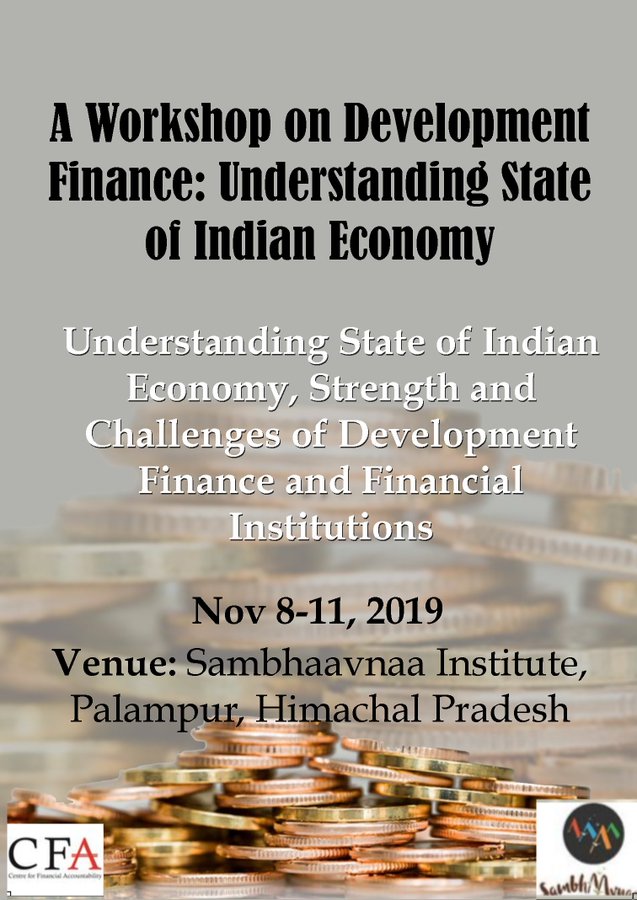
Finance is usually left to the experts, and is looked into in a silo, without looking into the interconnectedness with various other aspects, which governs our lives. This workshop will introduce different aspects of finance – looking at the fundamental premises on which the world of finance is systematically built, understanding the role of financial institutions beyond lending/banking, addressing the contemporary issues related to finance in India and critically looking at the gaps in governance, transparency and accountability in finance / of financial institutions. The workshop will try and make finance palatable and highlight the integral nature of finance in all walks of our lives.
Specifically, the workshop will try addressing a few questions:
- What is the socio-political context in which the world of finance is thriving?
- What are the sources of finance? The role of finance in pushing private capital and investments in various sectors.
- How does global finance work? Who are the key actors and institutions involved? What is their structure? Who owns them? What role do they play in countries like India? What strings are attached to investments? What are the impacts of global finance sponsored projects?
- What is the changing landscape of national finance? Who are the regulators, what role do they play?
- What are different attempts by people world over to hold banks accountable?
- And, what can we do?
The module takes an interdisciplinary approach and the sessions are non-technical. No prior training/reading in economics/finance is required. The sessions will be interactive in nature, and will be followed by Q&A and discussions. A set of readings will be provided in advance, reading it in advance will help students follow the sessions better.
Resource Persons
- Devidas Tuljapurkar, General Secretary AIBEA
- Soumya Dutta, Movement for Advancing Understanding on Sustainability And Mutuality (MAUSAM)
- Joe Athialy, Centre for Financial Accountability
- Madhuresh Kumar, National Alliance of Peoples Movements
- Vijayan M.J, Social Activist and Poltical Analysist
- Priyadarshini, Sr. Research Associate, CFA
- Benny Kuruvilla, Focus on Global South
Organised by:
Sambhaavnaa Institute Of Public Policy and Politics – http://www.sambhaavnaa.org
Centre for Financial Accountability – www.cenfa.org
Find the schedule of the workshop here: Programm Schedule -Nov 2019 Oct 10 Palampur
