
Finance Matters | Volume 9, Issue 29, January 30, 2026
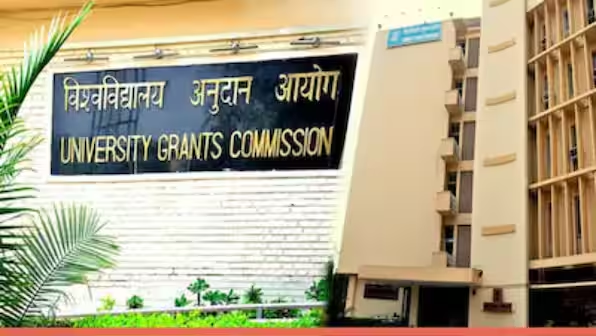
 Within weeks of the new University Grants Commission (UGC) rules’ announcement, India’s barely concealed casteism has come out in full swing. The University Grants Commission (Promotion of Equity in Higher Education Institutions) Regulations, 2026 lays out provisions to create Universities safe from caste discrimination, including setting up Equal Opportunity Centres, Equity Committee and a 24-hour ‘Equity Helpline.’
Enraged by this, upper caste students across the country have staged protests in front of colleges, Universities and the UGC office in Delhi. Beyond students, these regulations have also sparked dissent within the BJP with party leaders and workers writing letters to senior leaders and resigning from posts. Students in Rajasthan have warned of state-wide protests, social media is heightened with tension calling for the unity of ‘general category’ students – an obvious moniker for savarna and brahmin students. Even Professors and lawyers have staged protests against these rules.
Amidst these rising tensions, the reason why these rules came into force are forgotten. In 2019, Abeda Salim Tadvi and Radhika Vemula filed a petition at the UGC questioning how effective the 2012 Equity rules were in light of their children’ s institutional murders. Their children Payal Tadvi and Rohit Vemula both died of suicide after repeated bullying and caste-based harassment in Nair Hospital and Hyderabad Central University, respectively.
UGC data shows that between 2018-19 and 2023-24, caste-based discrimination in Universities went up by a whopping 118% Government data shows that among the 122 recorded student suicides between 2014 and 2021, over half of them were students belonging to oppressed caste backgrounds. Just last year, scholarships of nearly 3,500 students were delayed in colleges affiliated to Raja Mahendra Pratap Singh University in Uttar Pradesh and their scholarship forms were rejected for no reason. When the students attempted to speak with the Vice Chancellor, they were humiliated and insulted based on their caste location.
The National Overseas Scholarship has been providing students from Scheduled Castes, Scheduled Tribes and those belonging to landless agricultural families with scholarships since 1954. But in 2022, mere weeks before applications shut, the Government withdrew scholarships for marginalised students who want to study India’s history and culture abroad. Without consultation.
Casteism is sown into the very being of Indians. While on the surface the protestors claim that these rules can lead to discrimination against savarnas and misuse, the actual problem is as one law student openly admits: It will ‘disturb the social balance’ of University life. A balance tilting heavily in the favour of savarna students in visible and invisible ways while making it harder for oppressed caste students to survive, much less thrive.
– Team CFA
