

A Workshop on understanding plastics and it’s implications.
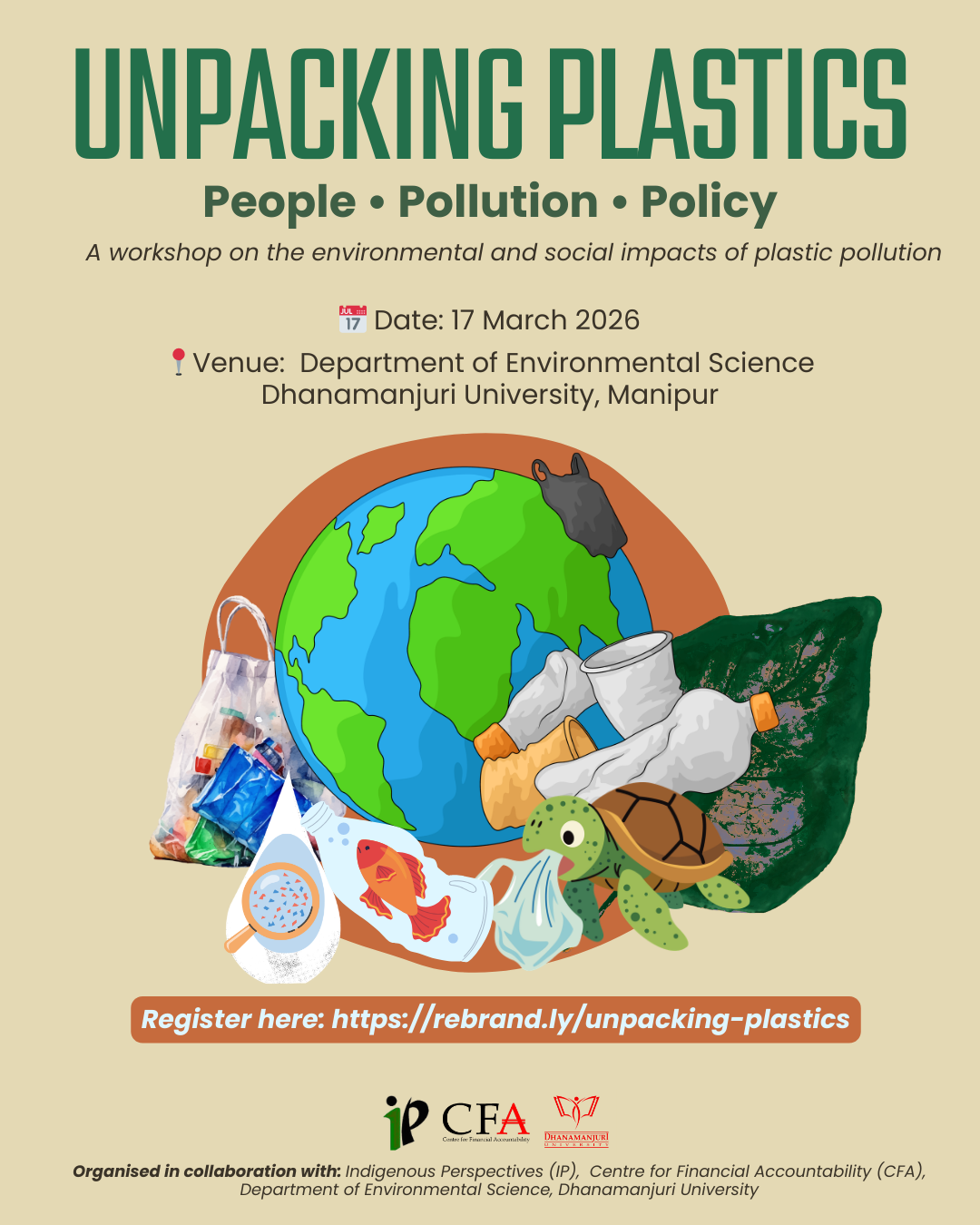 🗓️Date: 17 March 2026
📍Venue: Department of Environmental Science, Dhanamanjuri University, Manipur
Register here: https://forms.gle/18jwcS3P2tw4unuEA
Introduction and Rationale
Plastics have become a ubiquitous material in modern society, providing significant utility while simultaneously creating a multitude of complex problems. Globally and locally, the threats posed by plastic pollution to both the environment and human health have reached a peak, yet a comprehensive solution remains elusive. The reduction of the complex plastic crisis to merely a “litter problem” is a widespread misconception that obscures the full life cycle of plastic pollution, treating it as an issue of consumer behavior rather than a systemic industrial crisis. While visible plastic waste (bottles, bags) is a significant problem, it represents only a fraction of the total environmental, climate, and health impact of plastics.
In the state of Manipur, the challenge is particularly acute. This workshop seeks to “unpack” the lifecycle of plastics—investigating their fossil fuel origins, petrochemicals and the pathways through which they enter our daily lives and ecosystems. By situating this dialogue within an academic framework at Dhanamanjuri University, we aim to move beyond surface-level discussions and engage with the scientific, institutional, and social realities of plastic waste management. The focus must shift from cleaning up trash to comprehensive, upstream, system-wide changes, including strict limits on production and shifting to alternative materials.
Objectives
The primary objective of this one-day workshop is to build a collaborative bridge between the government, academic researchers, waste workers, affected communities, NGOs, and students. The meeting aims to:
- Analyze the Lifecycle: Understand the upstream origins and global supply chains of plastic materials.
- Evaluate Policy Frameworks: Examine the global, national, and state-level institutional frameworks governing plastic waste.
- Document Local Impacts: Provide a platform for those at the “receiving end” of dumping and those affected by emerging threats like microplastics.
- Foster Integration: Create a broad, multi-stakeholder approach to address plastic and waste issues specifically within the context of Manipur.
Thematic Sessions
The workshop is structured into four sessions/presentations/panel discussions, moving from global frameworks to local grassroots realities:
Part I: Unpacking Plastics – Global and National Frameworks
- Session A: Upstream Processes: An exploration of “What are plastics?” and an analysis of global supply chains.
- Session B: Institutional Landscapes: A technical review of the National Institutional and Policy Frameworks on plastic waste and how they translate to state-level governance.
Part II: Local Impacts and Responses
- Session C: Socio-Environmental Impacts: This session focuses on the local reality of plastic pollution, including the pervasive nature of microplastics etc.
- Session D: Management and Future Directions: Discussions will cover technical strategies such as the 3Rs (Reduce, Reuse, Recycle), waste segregation at the source, and the viability of Waste-to-Energy (WTE) initiatives.
Stakeholder Participation
The workshop will bring together targeted participants including:
- Government & Regulatory Bodies: Department of Environment, Department of MAHUD, Manipur State Pollution Control Board, and the Imphal Municipality Corporation etc
- Academia & Health: Students and faculty from Dhanamanjuri University and representatives from Community Medicine, RIMS.
- Frontline Workers: The Workers Union Manipur, representing those involved in the collection of unsegregated waste.
- Affected Communities: Representatives from the Lamdeng Village Authority (waste dumping site), Loktak Village, and Nambul River Clubs.
- Civil Society: Researchers, media professionals, and environmental NGOs.
This workshop is Co-organized by Indigenous Perspectives (IP), Centre for Financial Accountability, Dhanamanjuri University and Samatha.
