
A 2%-6% progressive wealth tax on just the 1,688 ultra-rich families (with Rs 1,000+ crore wealth) along with a one-third inheritance tax, can give us enough to be able to spend Rs 10.63 lakh crore annually on the people.

Over the last decade, people are being simply told to survive without asking questions. No matter what the circumstance, it is the ordinary hardworking Indians who find themselves on the roads, standing in the winding queues.
Demonetisation, for instance, had forced the poor onto the streets as they queued up in front of banks – something that Dhurandhar tried to legitimise on the silver screens in the name of fighting terror. Six years ago, the pandemic-induced lockdown forced millions of workers from the unorganised sector to leave cities and return to their villages. People had hardly recovered when rising prices and stagnant wages burnt whatever remained of their savings and forced them into indebtedness. And yet again, the war on Iran by the US and Israel has meant that the poor in India are once again queuing up. This time for LPG. The worst hit are migrant workers in the unorganised sector in the cities. They are once again on the move to go to their villages.
The only advisory from the government amid the crisis is that we need to endure. In fact, in the latest Economic Survey too, our chief economic advisor had the same advice for us. He said that given the global uncertainty, we ought not to look for “fleeting comfort” (preya) and rather opt for “enduring good” (sreya). The people of the country should not look for “quick fixes to visible, short-term pressures”, but rather suffer dutifully.
The widening gap
The fortunes of those at the top, however, have been markedly different. Oiled and greased by the freebies from the government, they have seen their wealth swell over the same period of time. The ingredients are a generous scoop of corporate tax breaks, a liberal helping of write-offs amounting to nearly Rs 20 lakh crore in just about a decade, slicing up of the environmental laws, and garnishing of anti-labour rules and public sector enterprises being served on the plate for privatisation.
From opulent weddings to brazen political clout, from near complete control over media narratives to mind-numbing net worth figures, what we are witnessing today is truly unprecedented in free India. The number of dollar billionaires in India rose from only one in 1991 to over 358 by 2025. Today, just 1,688 individuals in India hold a net worth of Rs 1,000 crore or more, with their total cumulative wealth surpassing Rs 166 lakh crore, representing nearly 50% of India’s GDP!
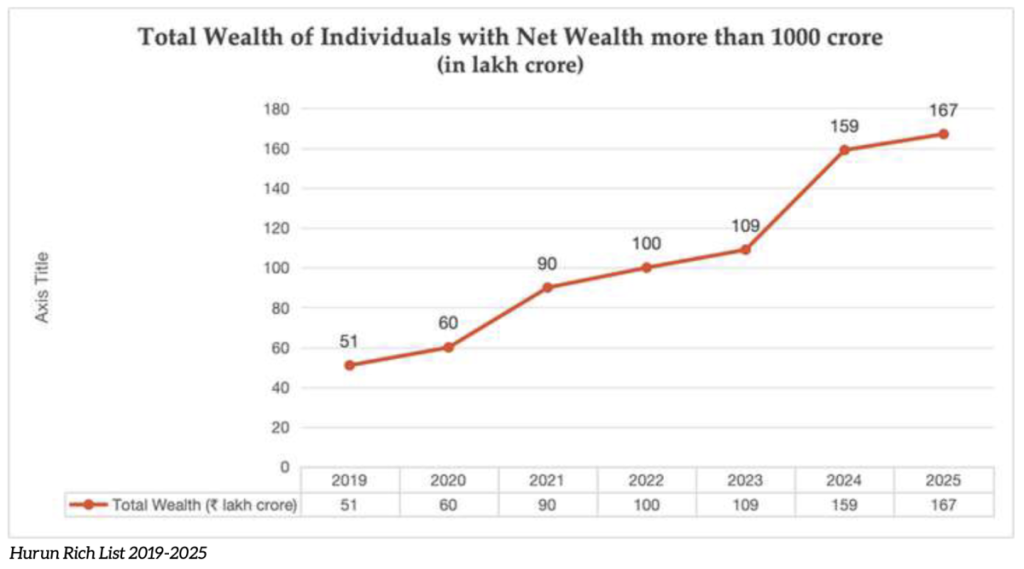
It is this grotesque reality that the recently released Wealth Tracker India 2026 seeks to expose. If we look at the five richest families in the country, their wealth rose to about 400% of its original level in just six years – from the time of the COVID pandemic until now.
This, when the share of wealth of the bottom 50% has dropped from an abysmal 6.8% in 2019 to an even lower 6.4%. The government has made major claims about lifting 250 million people out of multidimensional poverty in the last decade – but behind such headlines are convenient changes in methodology. The MPI doesn’t, for instance, include income poverty, which is the standard measure used in India. So while we hide poverty, the super rich display their private forests and public apathy.
Why not tax the ultra rich?
As the gap widens at an obnoxious rate between those at the bottom and the handful at the top, the attempt made in the report is to give a sense of exactly what a minimal tax on these ultra rich can translate into in concrete terms if we were to convert their taxable net worth into what we really need.
Mukesh Ambani’s wealth swelled by 153% from 2019 till 2025. A 2% wealth tax on Ambani’s gains over those six years would have put a free laptop in the hands of every Class 10 student in the country – for three consecutive years. Universal maternity support – Rs 18,000 to 2.85 crore women – costs Rs 51,300 crore a year. Ambani’s 2% could have covered almost two years of it.
Again, Gautam Adani’s wealth alone ballooned by a whopping 625%. The same tax on his wealth could have funded two full years of primary healthcare for every Indian. Or clean air for nearly eight crore families most choked by pollution. Tax Savitri Jindal’s wealth at the same rate, and you could have kept ST students in school – pre-matric, post-matric – for nearly a decade.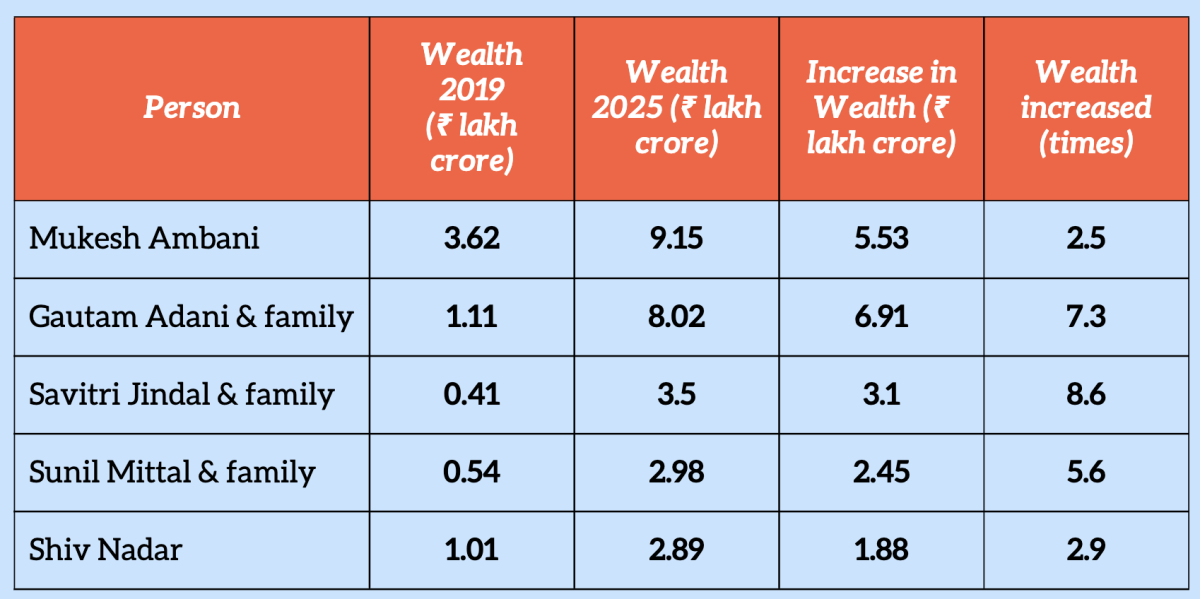
The report argues that a 2%-6% progressive wealth tax on just the 1,688 ultra-rich families (with Rs 1,000+ crore wealth) along with a one-third inheritance tax, can give us enough to be able to spend Rs 10.63 lakh crore annually on the people. This, for instance, could translate into immediately increasing spending on health and education by 1% of GDP, and providing Rs 12,000/month pension (half of living wage) to all elderly (who currently receive a shameful Rs 200/month from the Union government).
While the government is reluctant to spend a dime more on social security and welfare, it is crucial that we articulate the demand for taxing the ultra rich in a language that connects with the masses. The compilation is designed to aid that process. More often than not the figures of lakhs of crores of wealth being amassed by the billionaires at an astonishing pace is difficult to even fathom. It is an attempt to make the demand for a wealth tax more tangible, more legible, something that we can all relate to in our day to day lives.
The juju of capital flight
Children in Bengal are often softened to sleep at night by mothers as they say, “Go to sleep, or juju will come!” What’s juju? One can say it’s a boogeyman, a made-up fear. Similarly, every time there is a talk of wealth tax, the response is the juju of capital flight. The most common argument against taxing the rich is that higher retained profits will translate into greater productive investment.
However, in India, rising corporate profitability has not been accompanied by a commensurate increase in employment-generating investment. Even the economic advisor has been seen lamenting the fact that the soaring profits of the corporates are hardly shared in the form of wages. This helps explain the persistence of unemployment and low-paying precarious jobs despite relatively high GDP growth. At the same time, India’s expenditure on research and development remains around 0.6% of GDP, with limited contribution from the private sector. This suggests that the rich elite India doesn’t want to channel their profits into long-term capacity building or technological upgrading, but on short-term financial returns. A wealth tax can in fact boost the economy by boosting demand from the bottom.
Anirban Bhattacharya and Raj Shekhar are part of the Centre for Financial Accountability. Jacob Joshy is a PhD scholar at Jawaharlal Nehru University, Delhi.
This article was originally published in The Wire and you can read here.
Centre for Financial Accountability is now on Telegram and WhatsApp. Click here to join our Telegram channel and click here to join our WhatsApp channel and stay tuned to the latest updates and insights on the economy and finance.
