
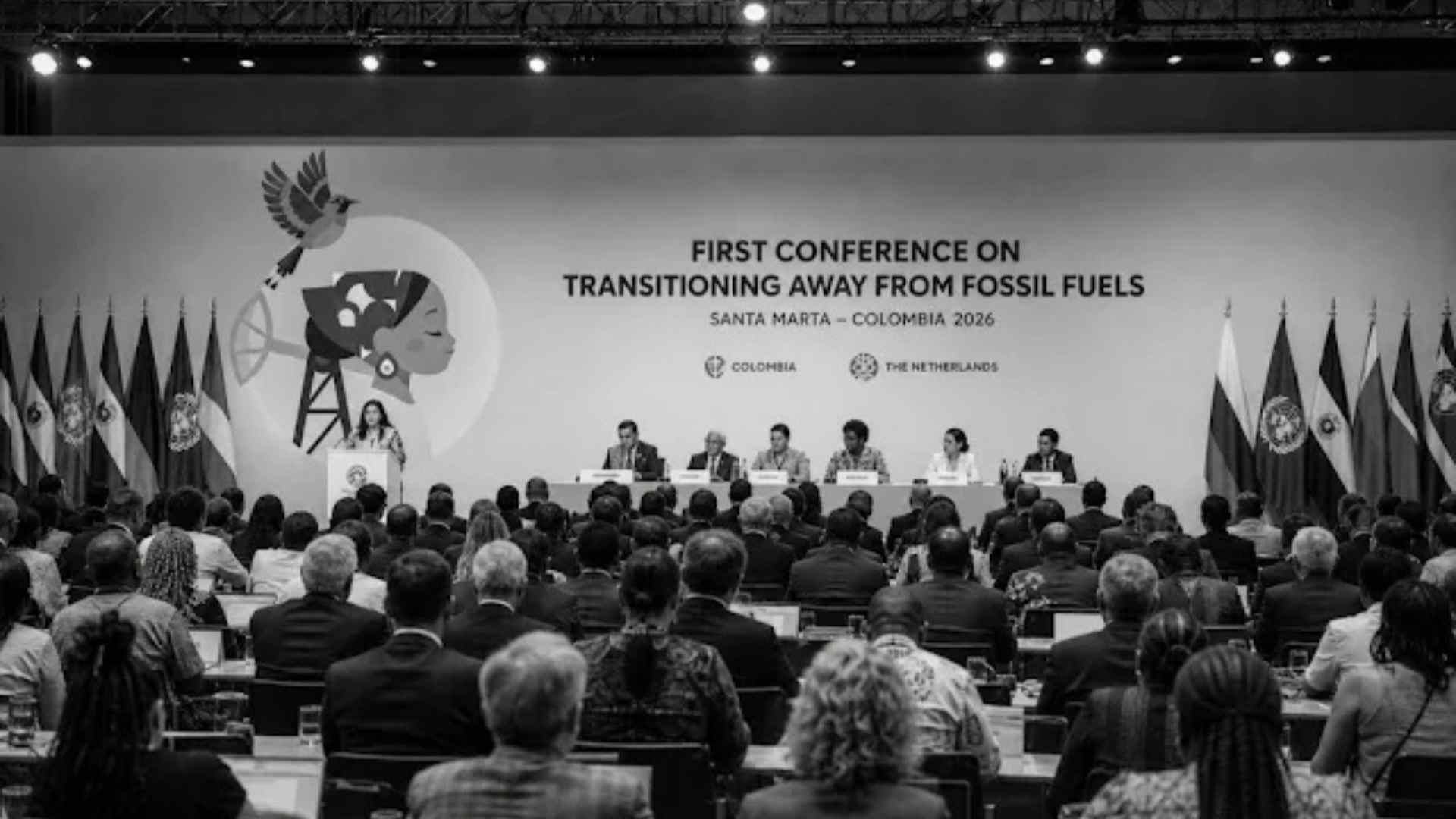
When Colombia and the Netherlands convened the First Conference on Transitioning Away from Fossil Fuels in Santa Marta at the end of April 2026, the intent was clear: to move beyond broad commitments and begin structuring pathways for implementation. Over five days, 57 countries — alongside a wide spectrum of stakeholders including representatives from subnational governments, academia, social movements, NGOs, trade unions, parliamentarians, the private sector, multilateral development banks, Indigenous Peoples, peoples of African descent, peasants, children and youth, and women and diversities — came together to focus on a question that has long remained politically fraught within formal climate negotiations: how to actually move away from fossil fuels.
In many ways, Santa Marta — an outcome of a coalition-led initiative — marked a departure from the familiar style of the UN climate process under the United Nations Framework Convention on Climate Change (UNFCCC). It created a parallel space, one not bound by the consensus-driven approach that often slows progress at the Conferences of the Parties (COPs). This allowed a group of willing countries — or the “coalition of the willing” as the conference positioned itself — to engage more directly with the practicalities of phasing out fossil fuels.
That shift mattered. Unlike recent COP outcomes — such as COP30 in Belém — where even referencing fossil fuels proved contentious, Santa Marta placed them at the centre of discussion. Another notable difference was the absence of the usual negotiating configurations. Instead of engaging primarily through groupings such as developed and developing countries, Least Developed Countries (LDCs), or small island states, participants interacted in a more fluid space cutting across economic and political contexts.
At the same time, the very features that made Santa Marta refreshing also raise questions about its global significance. The absence of three of the world’s largest emitters — the United States, China, and India — is likely to limit the initiative’s ability to shape outcomes at a global scale. Even so, the countries that did participate together account for roughly a third of global GDP, suggesting that the initiative still carries some weight.
From Dialogue to Structure
Where Santa Marta appears to have made progress is in attempting to institutionalise follow-up to the conversations initiated at the conference. Five key outcomes, as outlined in the co-host takeaway document, point to an effort to move beyond one-off dialogue.
First, there is a clear plan for continuity. A second conference has already been announced for 2027, to be co-hosted by Tuvalu and Ireland. This signals an intention to sustain the momentum.
Second, a coordination group will bring together countries leading already existing alliances and initiatives, alongside the conference co-hosts. This is an attempt to avoid duplication and to ensure some degree of improved coordination across efforts.
Third, the organisers have tried to connect this process with the broader UN system. From the outset, the co-hosts have been careful to position the conference as an initiative that complements, rather than replaces, the COP process under the UNFCCC. The outcomes from Santa Marta will be shared with upcoming meetings, including future COP discussions and the Global Stocktake. This is important, as such initiatives cannot substitute for the main multilateral process.
Fourth, and perhaps most substantively, the conference has initiated three workstreams focused on implementation. These include support for developing transition roadmaps aligned with national climate commitments, primarily through technical assistance, knowledge-sharing, and peer learning; addressing macroeconomic and financial dependencies on fossil fuels, including examining issues such as debt, subsidy structures, and fiscal reliance; and aligning fossil fuel producers and consumers to enable structural shifts in trade and energy systems through dialogue and coordination. Notably, these workstreams attempt to engage with some of the trickiest questions around transition — debt constraints, subsidy reform, and the revenue implications of transition. Their effectiveness, however, remains to be seen.
Finally, a Science Panel for the Global Energy Transition has been launched to support countries with technical guidance. The aim is to align national plans with 1.5°C-aligned scenarios and to bridge the persistent gap between scientific guidance and policy implementation.
Between Promise and Limitation
Taken together, these outcomes suggest that Santa Marta was more than a symbolic gathering. It has set in motion a process that seeks to connect political intent with technical support and practical, implementable action. At this stage, however, the precise role of this process remains somewhat unclear. It appears to be positioning itself as a platform for coordination and agenda-setting — potentially enabling technical exchange, aligning national transition efforts, and generating political momentum that can feed into formal negotiations — rather than as a body with direct financing or decision-making authority.
However, caution is necessary. Climate governance is already crowded with coalitions, alliances, and platforms, many of which struggle to translate ambition into real change. Whether the Santa Marta process will evolve into a meaningful pressure point within the UN climate process, or remain a more limited forum for dialogue and coordination among participating countries, will depend on its ability to deliver tangible progress before the next conference in 2027.
More fundamentally, its effectiveness will depend on how successfully it connects with the broader UN processes. If it succeeds in feeding concrete proposals and momentum into formal negotiations under the UNFCCC, it could help break some of the stalemates that have characterised recent COPs. If not, it risks becoming another parallel track — relevant for some, but with limited influence on global decision-making.
India’s Position
India’s Position
India’s absence from Santa Marta stands out. It does not appear to have been invited to participate, with organisers focusing on countries that had supported a more ambitious fossil fuel roadmap at COP30. In that sense, Santa Marta’s “coalition of the willing” was shaped not just by participation, but by alignment on ambition. While this may have helped create a more focused and less contentious space for dialogue, it also highlights a key limitation: excluding major economies such as India risks narrowing the scope and impact of such initiatives, particularly when their participation is critical to any meaningful global transition.
This is closely linked to India’s evolving stance on fossil fuels. In global climate negotiations, India has consistently supported “phasing down” rather than “phasing out” fossil fuels, pointing to its development and energy security needs. Its reported decision to step back from bidding to host COP33 similarly suggests a more cautious approach to global climate engagement, with domestic priorities taking greater precedence. This, in turn, underlines the importance of India signalling a greater willingness to engage and accelerate the phase-down of fossil fuels, even as it navigates these constraints.
At the domestic level, the scale and structure of India’s coal economy further complicate this picture. India is one of the largest producers and consumers of coal, and its coal economy is deeply labour-intensive. Around five lakh mine workers are directly employed in the sector, alongside a much larger contractual and informal workforce, and a wide network of livelihoods linked to transport, services, and local economies. Given this reality, as in many other countries, transition is not just an environmental question for India — it is a complex socio-economic one, with wide-ranging implications for jobs, regional economies, and local communities.
This, in turn, raises a more fundamental question of how the transition is planned. As acknowledged in the co-host takeaway document, moving away from coal cannot follow a one-size-fits-all, top-down approach. In India, it will require sustained public dialogue with workers, communities, and governments, especially in regions that depend heavily on coal for livelihoods and local economies. Planning will need to be anticipatory, participatory, and place-based, with clear support for affected workers and realistic alternative livelihoods. Without this, the transition risks becoming politically contested, socially disruptive, and repeating older patterns of exclusion under a new label.
Looking ahead to the 2027 conference, there is a strong case for deeper engagement on both sides. For India, participation would allow it to influence the direction of these conversations and ensure that the realities of coal-dependent economies are better reflected. At the same time, for the Santa Marta process to have meaningful global impact, it will need to find ways to bring major economies such as India into the conversation. Without this, the initiative risks remaining a coalition of aligned countries rather than evolving into a platform capable of shaping broader global outcomes.
An Experiment in Motion
Santa Marta represents an interesting experiment in climate cooperation. It reflects the idea that waiting for consensus among nearly 200 countries may not be sufficient to drive the pace of transition required. At the same time, it acknowledges — at least in intent — that such efforts must ultimately connect back to the multilateral system.
At this stage, however, its position within the broader global climate architecture remains unclear. It is not yet evident whether Santa Marta will evolve into a meaningful pressure point within the UN process, a platform for coordination and technical exchange among participating countries, or remain a more limited forum for dialogue. How this identity evolves will shape both its relevance and its ability to influence global outcomes.
If the initiative is to move beyond this ambiguity, it will need to demonstrate tangible value. As a coalition of the willing, it carries the potential to set a precedent — showing what more ambitious and coordinated action on fossil fuel transition can look like in practice. This would require not just political signalling, but concrete steps, particularly from higher-income countries within the coalition, including increased financial flows, stronger support for knowledge-sharing and capacity-building, and more deliberate efforts to address structural constraints in countries dependent on fossil fuels.
At the same time, for the initiative to have meaningful global impact, it cannot remain confined to a relatively aligned group of countries. Finding ways to engage more effectively with major economies such as India will be critical. Without this, the process risks reinforcing existing divides within climate politics rather than helping to bridge them.
Whether this experiment succeeds will ultimately depend on delivery: whether roadmaps are developed, finance is mobilised, and cooperation translates into measurable shifts away from fossil fuel dependence. For now, Santa Marta offers a glimpse into a more implementation-focused, coalition-driven approach to climate action. Whether it can move from promise to measurable impact is a question that only the next few years — and the lead-up to 2027 — will answer.
This article was originally published in Counterview you can read it here.
This article was originally published in Counterview you can read it here.
