
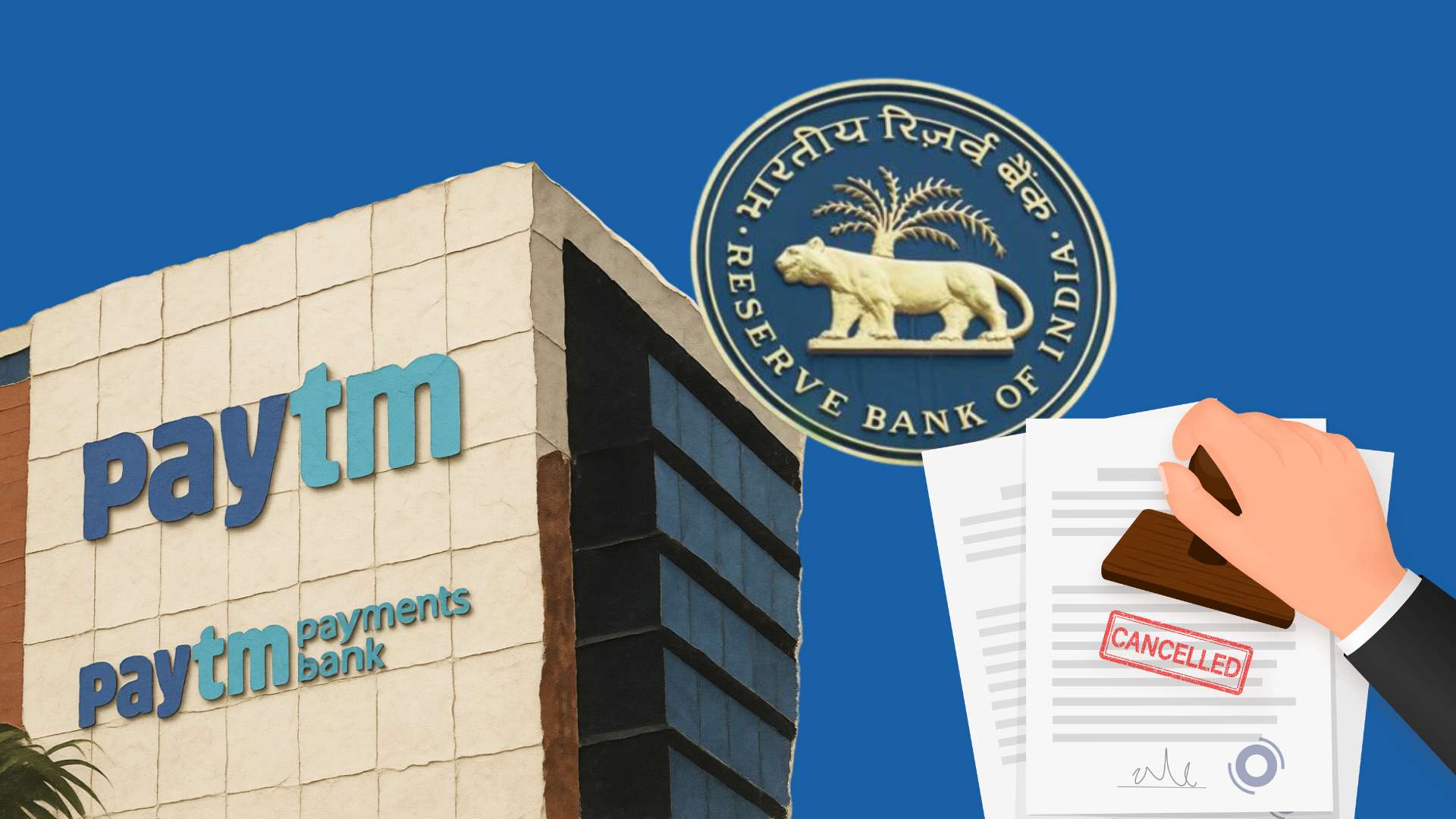
 RBI has cancelled the licence of Paytm Payments Bank Ltd on 24th April, 2026, more than two years after barring it from accepting deposits or top-ups. The move effectively prohibits the Payments Bank from carrying out any banking business, following years of regulatory friction caused by persistent non-compliance.
RBI has repeatedly flagged serious concerns in the bank’s operations, which ultimately led to this action. In its statement, the RBI has said, “The affairs of the bank were conducted in a manner detrimental to the interest of the bank and its depositors.” “The general character of the management of the bank is prejudicial to the interest of depositors as also the public interest.” “No useful purpose or public interest would be served by allowing the bank to continue.”
Previously, the RBI had taken some actions against Paytm Payments Bank in March 2022 by barring it from onboarding new customers, following supervisory concerns around its compliance processes, particularly in areas such as KYC.
In March 2024, the RBI imposed stricter restrictions on Paytm Payments Bank, prohibiting it from accepting new deposits, processing credit transactions, or allowing top-ups in customer accounts, wallets, FASTags, and NCMC cards. Paytm was also accused of selling data to some Chinese companies. As reported in the bank’s Annual Report 2025, more than 14,500 employees and around 66,000 Business Correspondents were associated with the institution. What will be their fate?
It is high time to review the entire Payment Bank model. In the name of banking sector liberalisation and reforms, RBI appointed the Nachiket Mor Committee in 2013, and this committee recommended the Payments Bank model to help small businesses and low-income households. RBI gave approval to start 11 such Payments Banks. Out of this, only some banks were started. Aditya Birla Payments Bank was shut down in 2019 due to non-viability. Cholamandalam Payments Bank was never launched and surrendered its in-principle approval. Vodafone m-Pesa surrendered its licence. Tech Mahindra and Sun Pharma never launched and surrendered the approvals citing viability.
Jio Payments Bank Ltd has made a loss of Rs. 103.85 crores in 2024–25. The annual turnover was only Rs. 38.23 crores, in spite of a claim of having 14,291 Business Correspondent outlets. SBI, which had contributed 30% of the share in the beginning, sold out the shares step by step and quit in June 2025. While joining itself, SBI was criticised by the associations and unions.
Airtel Payments Bank was fined Rs. 5 crores in 2018 for opening accounts without consent, and it was not allowed to onboard new accounts for 4 months. It has made a loss of Rs. 1900 crores in 2024–25. It had a deposit of a mere Rs. 3,418 crores. Is it worth running?
Now RBI has cancelled the licence of Paytm Payments Bank. This cancellation of licence to Paytm Payments Bank is not merely the closure of a single institution; it raises serious questions about the long-term viability of the Payments Bank model itself. Their future now remains uncertain.
In November 2016, just after demonetisation, the Prime Minister appeared in full-page advertisements of the Paytm company promoting digital banking. The banking arm was inaugurated by the then Finance Minister Arun Jaitley. Today, the situation raises uncomfortable questions about how that vision has been implemented on the ground. With a customer base of nearly 9.5 crore, the disruption is not confined to the institution alone. Around 66,000 Business Correspondents were serving across nearly 15,000 villages in about 540 districts, acting as the last-mile link for basic banking services. What happens now to these customers—especially those in rural and underbanked areas—who relied on this network for their daily financial transactions? The issue of accountability of RBI cannot be avoided.
Other than these, there is only one Payments Bank, i.e., Postal Payments Bank, which should be converted into a universal bank in the public sector. That was the original proposal.
‘Payment banks are specialized, tech-driven financial institutions licensed to promote financial inclusion by offering basic services like accepting demand deposits (up to ₹2 lakh per user), providing savings/current accounts, and facilitating remittances. They cannot offer credit cards or loans but issue debit/ATM cards and distribute third-party financial products like insurance.’
Banking is the collection of deposits and lending the same. But a Payments Bank is a misnomer. When collection of deposits is restricted and loans are prohibited, how can a bank function?
This model was bound to fail. RBI failed to notice that.
There are five questions which need to be addressed.
- The structure itself is flawed and came under criticism in 2014 itself. Based on the experience, it’s high time to stop this model. When will RBI do it?
- What monitoring has RBI done? Why was there a delay of 4 years in taking a decision? In 2022 itself, the licence should have been cancelled along with cancellation of the permission to continue as a Non-Banking Finance Company. If the failure is attributed to the bank’s management, then what concrete actions did RBI take? What about RBI’s accountability? 9.5 crore customers across the country are at risk of loss.
- Allowing the private sector in banking to deal with people’s money is a huge risk. Apart from the Payments Banks, the mushrooming of Non-Banking Financial Companies charging huge interest, fines, and using cruel recovery methods is under question across the country. All India Democratic Association has brought out a detailed report on this issue. RBI is preventing state governments from taking action against NBFCs for malpractices, though money lending is a state subject. RBI has written to state governments that NBFCs are under their control and that state governments should not enact laws to take action against them. This is a serious flaw.
- There are serious concerns about private banks, including large ones like ICICI and HDFC, which need serious action by the RBI. All India Bank Employees Association has demanded nationalising all private banks, which needs consideration in the larger interest of the huge population, out of which 60% of adults who need credit do not have access to formal credit. Various inequality reports on India are alarming and can be addressed by public sector banks.
- Financial inclusion, including access to credit, can be achieved only by government-owned banks, which can direct credit as was done in the past.
It is high time for a larger debate inside and outside RBI, which needs to be initiated by the RBI.
With serious changes taking place in the banking sector, huge write-offs, and foreign banks increasing their shareholding in private banks in India, we require fresh debates in Parliament and outside. The Department of Financial Services under the Government of India cannot remain a mute spectator. The initiative should start from there. The ball is in their court.
Thomas Franco is the former General Secretary of the All India Bank Officers’ Confederation and a Steering Committee Member at the Global Labour University.
Centre for Financial Accountability is now on Telegram and WhatsApp. Click here to join our Telegram channel and click here to join our WhatsApp channeland stay tuned to the latest updates and insights on the economy and finance.
