
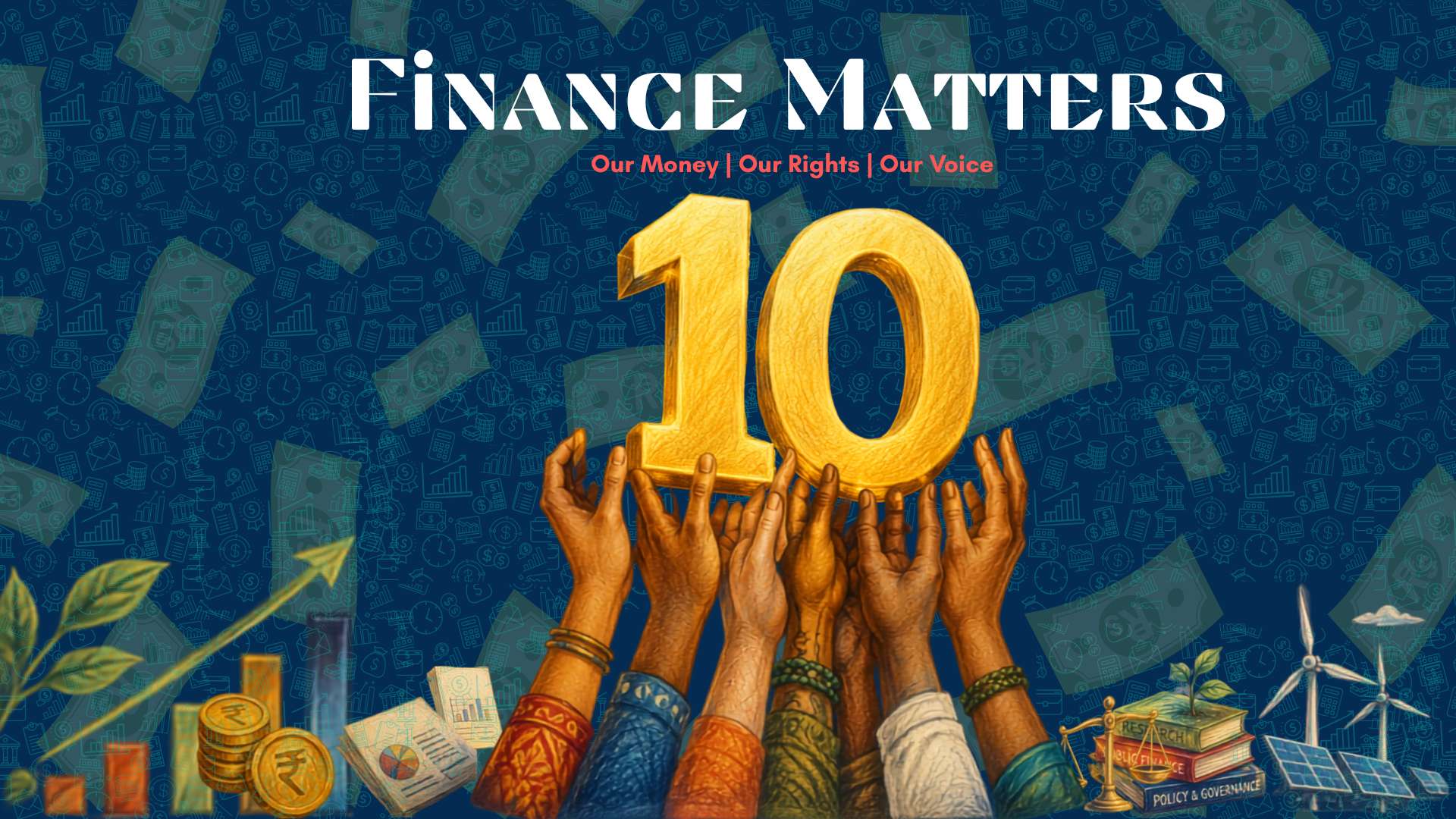
Ten years ago, a newsletter started with a fairly stubborn premise: that ordinary people are entitled to know where public money goes, who profits when it disappears, and why the explanations offered are usually designed to be forgotten by lunchtime. A decade later, the premise hasn’t changed. We’ve just gotten better at proving it.
The early issues went after a banking bill that would have let depositors absorb a bank’s losses, dressed up in the language of “resolution” – The Financial Resolution and Deposit Insurance Bill, 2017. That fight, Parliamentary Committee hearings, coalition-building, endless explainer pieces taught us something we’ve relied on ever since: policy only survives on public confusion, and confusion is beatable with enough patient, repeated explanation.
Everything followed from that. We sat through demonetisation’s anniversaries long after the news cycle moved on. We logged the bank scams as they came – PNB, DHFL, Yes Bank, ABG Shipyard, not as isolated failures but as a single story about who gets bailed out and who gets billed. We asked who actually benefits from bullet trains and smart cities and asset monetisation, and kept asking even when the answer was obvious and nobody in power wanted it said plainly. We tracked bauxite mining in Odisha, an ethanol mandate quietly loading costs onto consumers, and a port project on Great Nicobar moving ahead as though the island were empty.
Some of that reporting turned into something more than reporting. Years of writing on the Kodungaiyur waste-to-energy plant became ground support for the No-Burn Chennai coalition, standing with residents and environmental groups who’d had enough of being told incineration was progress. We ran that alongside a set of workshops, on fossil fuels and plastics, on unpacking plastic policy and corporate responsibility, built to hand our allies the same evidence base we were using, so the argument didn’t depend on us alone. When Chennai’s incinerator plants stalled, it wasn’t a story we watched from outside.
Our writings on household debt led us to Nagercoil, where we spent time with MALAR, a self-help group run entirely by women, to understand what debt looks like from inside a household rather than a policy paper. Our inquiry into the exacerbating wealth inequality helped us go deep into it and published the Wealth Tracker India report, following the wealth this country protects even while claiming it can’t afford to tax it, now increasingly told through video for readers who’ve had enough of paragraphs.
And because a newsletter is only as strong as the people telling stories alongside it, we spent real hours on capacity building, as in the case of three recent workshops, Reclaiming the Narrative, Stories in Numbers, and Telltale Stories, all built around one question: how do you get someone to actually finish reading a story about a spreadsheet?
Along the way, the government cancelled our FCRA. We’d like to say we were surprised. We weren’t. Apart from taking it as a recognition for what and how we did (and doing), we were also assured that someone in the regime is reading what we write. What else do you ask for! Losing that registration didn’t buy the silence someone was hoping for, it made us recheck the spellings and grammar better, while publishing sharper and deeper pieces.
None of the last ten years belongs to one team. We were fortunate to get guided by economists, bankers, activists, academics, researchers and even fellow citizens in this short journey. Finance Matters belongs to all of them. It belongs to Thomas Franco, a friend and mentor who never got tired travelling this bumpy ride with us, whose widely read column Random Reflections will complete 8 years in a few months. It belongs to every reader who forwarded an issue instead of scrolling past it, and every activist who handed us a story before it was safe to tell.
We’ve missed things, moved slowly on things, and could still do better on most fronts. That’s not modesty, it’s the actual scorecard, and it’s the reason there’s an eleventh year to work toward.
Bringing out Finance Matters regularly is possible only when you support it financially. Do spare a donation and help our appeal reach farther.
Ten years in, the questions haven’t gotten smaller. If anything, more people are asking them with us now than when we started. That’s the anniversary worth marking.
– Joe Athialy, Executive Director
