
AT A GLANCE
- The combined wealth of Mukesh Ambani, Gautam Adani & family, Savitri Jindal & family, Sunil Mittal & family, and Shiv Nadar increased by 400% from 2019 to 2025
- Ambani’s wealth increased by 153% from 2019 to 2025 while Adani’s increased by a whopping 625%
- If only a 2% wealth tax had been collected on Mukesh Ambani’s wealth from 2019 to 2025, it would have generated enough resources to provide free laptops to all Class 10 students for three whole years.
- Again, providing ₹18,000 to 2.85 crore women would cost about ₹51,300 crore annually, meaning this could finance nearly two years of universal maternity rights.
- Similarly, a 2% tax on Adani’s wealth for the same years could fund two full years of primary healthcare for the entire country.
- It could for instance provide free air purifiers to nearly 8 crore families most affected by bad air.
- A similar tax on Savitri Jindal could have funded ST pre-matric and post-matric scholarships for nearly a decade. Alternatively it could provide ₹10,000 each to 2.5 crore girl students to boost their learning quality in school.
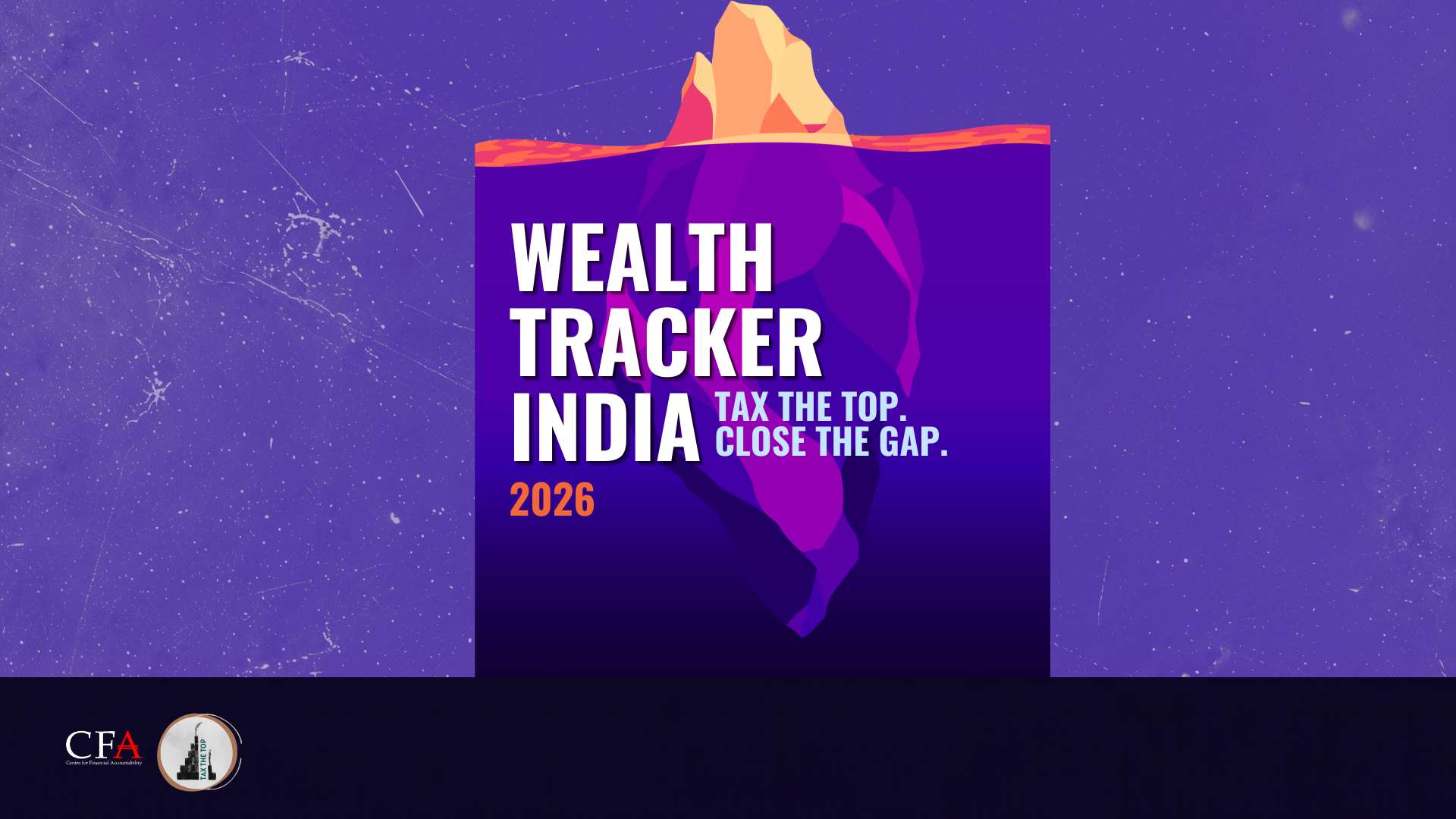
New Delhi, April 1, 2026: A new report, Wealth Tracker India 2026 released today brought out some startling facts about the widening wealth inequality in India. While 5 richest families amassed an increase of their wealth by 400% between 2019 and 2025, the wealth share of the bottom 50% has stagnated at 6.4% by 2024.
The report, published by Centre for Financial Accountability & Tax The Top campaign noted that the inequality has reached levels in India that are grotesque and often unfathomable for a common person. Today just 1,688 individuals in India (as per the Hurun rich list) hold a net worth of ₹1,000 crore or more with their total cumulative wealth surpassing ₹166 lakh crore, representing nearly 50% of India’s GDP!
The report argued that a 2%–6% progressive wealth tax on 1688 ultra-rich families (with ₹1000+ crore wealth) + one-third inheritance tax can give us enough to be able to spend ₹10.63 lakh crore annually on the people including Immediately increase health spending by 1% of GDP, increase education spending by 1% of GDP, Provide ₹12,000/month pension (half of living wage) to all elderly (who currently receive a shameful ₹200/month from central govt) and other welfare measures.
These findings expose the claim by the government that no resources are available to increase its investments on welfare. While the government cuts the taxes for the corporations, it is deeply disturbing that today hard working individuals are paying more taxes than the big corporations. On top of that the government has written off an astonishing ₹19.6 lakh crore of loans during the last 11 years!
Recently an Extraordinary Committee of Independent Experts on Global Inequality commissioned by the G20 and headed by Joseph Stiglitz underscored that these outcomes are ultimately a “policy choice,” reversible through progressive and wealth taxation and other redistributive tools. Sadly such discussions are disturbingly missing in the policy circles here in India even as we drift further and further away from our Constitutional obligations of countering concentration of wealth. On the contrary we abolished whatever existed in the name of wealth tax in 2016.
Urgent Need to Demand Wealth Tax in India
In the context of new findings on wealth inequality, Centre for Financial Accountability and Tax The Top campaign demand for implementation of a Wealth Tax to reduce the gap between the ultra wealthy and the poor, and to meet the basic needs of the citizens through welfare measures.
Quotes:
“There are two Indias today. One of the handful at the top whose wealth has been soaring by lakhs of crores. And another India that is indebted, precariously employed, and largely from marginalised sections struggling to make their ends meet. The wider this gap, the farther the idea of India in the Constitution goes away.”
Anirban Bhattacharya, Campaigns Director of Centre for Financial Accountability
“Over the last decade, people are being told to survive without asking questions – from demonetisation to pandemic and now the LPG-Coal crisis. It is hardworking Indians who are on roads and standing in queues. While in the same period, India’s handful of super rich are given free passes to continue their loot. It is the need of the hour to put a wealth tax on these super rich to generate the resources we need to strengthen public services and address the inequality that threatens democracy.”
Raj Shekhar, Tax The Top Campaign
“Existing data reveal a stark concentration of wealth at the very top. Yet wealth and inheritance taxes remain absent from the political imagination or policy spaces. Grotesque inequality is now normalised. Wealth Tax is no magic bullet, but as the report suggests, it can universalize basic rights for the poor.” Jacob Joshy, Researcher of the Wealth Tracker India 2026 report
About Tax The Top Campaign
The TaxTheTop campaign is an initiative driven by people’s movements, trade unions, civil society organisations, and ordinary citizens. We demand a wealth and inheritance tax on the country’s super-rich to generate resources that ensure universal social and economic rights for all. For more: www.taxthetop.org
About Centre for Financial Accountability
The Centre for Financial Accountability works at the intersection of research, campaigning and activism on issues related to financial institutions and the economy. It demystifies the world of economy to common people and aims to strengthen and improve financial accountability. For more: www.cenfa.org
