
Finance Matters | July 24 2026
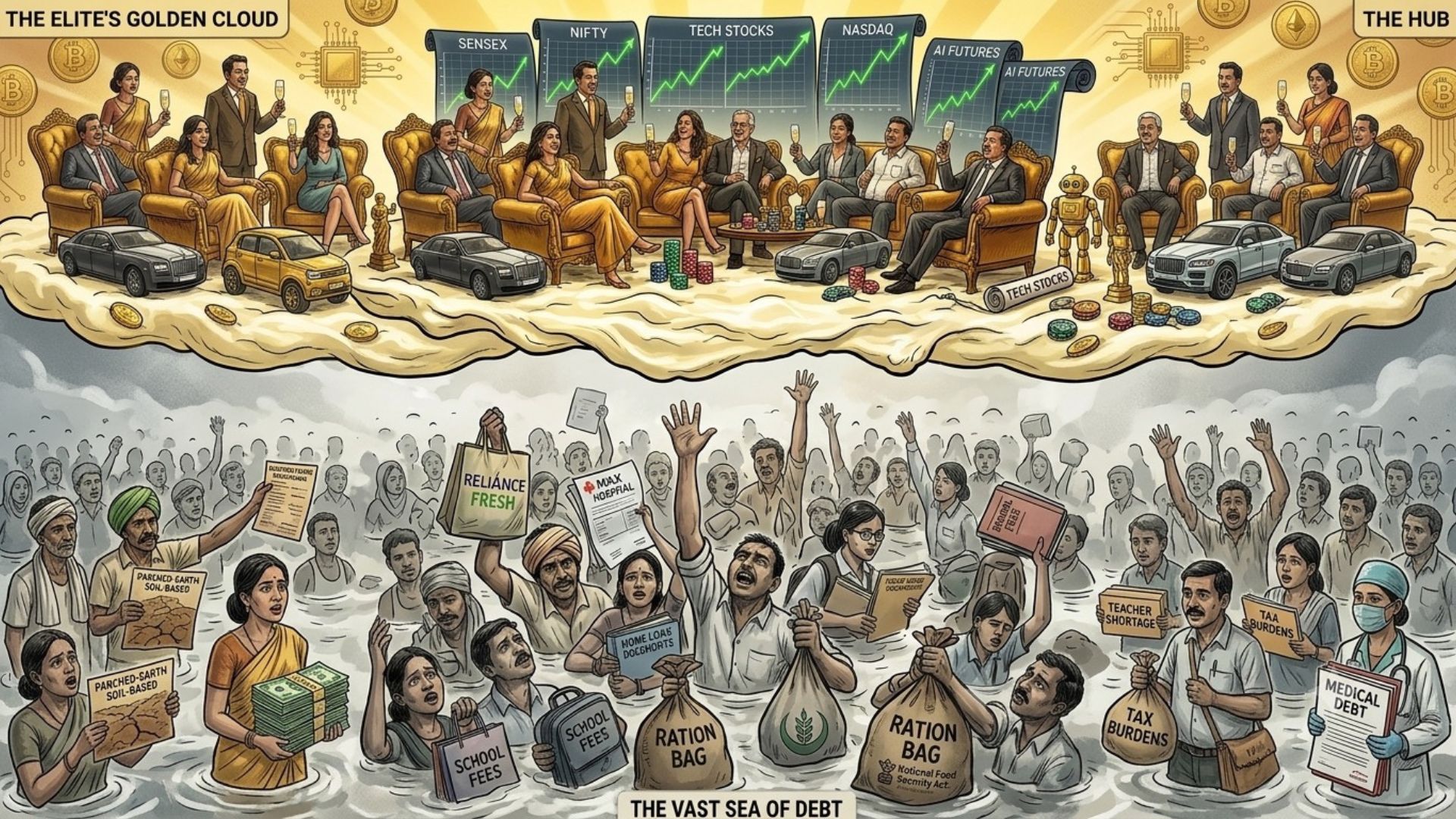
India has two realities, like two parallel universes. In one of these universes a handful of super rich seem to be doing great, in fact they are thriving. While the other India including both the poor and the middle classes are somehow making ends meet, like “cockroaches” surviving on crumbs.
As per the government’s own admission in the parliament, the number of Indians having reported their annual income to be Rs 100 crore or more has increased four-fold in five years. Like our Wealth Tracker India report 2026 showed, between 2019 till 2025 individuals with 1000 crores and above in terms of headcount grew by 77%! In the same time period, their wealth grew by a staggering 227%! A joint report by 360 One and Crisil Intelligence shows that India is home to 3,040 individuals worth at least ₹425 crore each, together commanding over ₹104 trillion in wealth — nearly a fifth of which, or ₹19.72 trillion, is held by just 10 people.
This is the India that is floating like a thin layer of malai (cream) at the top while the “cockroaches” at the bottom is suffocating. Real wages have either stagnated or declined in the last decade as earnings are hardly catching up with incomes. Recent research shows a vegetarian thali (an Indian meal comprising several small dishes) now costs 11% more each year, an entry-level car or motorcycle rises by 7 to 8% annually and medical costs climb at 14%. According to the Rural Economic Conditions and Sentiments Survey by the NABARD, the proportion of rural households reporting an increase in income during last year has exhibited a consistent decline since the November 2025 round, reaching 27.7% in July 2026, the lowest level recorded since the inception of the survey.
This gap between what people earn and what life costs is filled increasingly with debt. These are not loans for investments or for building a new asset, no. It is simply to pay for reproducing life – hospital bills, consumption spending, education fees, etc. India’s non-housing household debt as a share of income now exceeds that of the United States and China. Almost half of all Indian families have taken personal loans and nearly 70% of borrowers had their first loan before the age of 30. And people are spending nearly 40% of annual income in servicing the loans.
While the malaidaar (the rich) at the top are spending on luxury goods and holidays, that can never be near enough to boost the economy. Mass demand is dwindling pulling the economy down while the super rich splurge. FMCG volume growth has dropped from 11% some 14 years ago to 3% today. Car sales are stagnant. Consumer durables growth has collapsed from 11% to 1-2%. These numbers are alarming. While there are a number of divisive rhetoric being thrown at us from time to time to raise false alarms about imaginary enemies, the real divide, the real problem is staring at us in our eyes – the widening inequality.
Centre for Financial Accountability is now on Telegram and WhatsApp. Click here to join our Telegram channel and click here to join our WhatsApp channeland stay tuned to the latest updates and insights on the economy and finance.
