
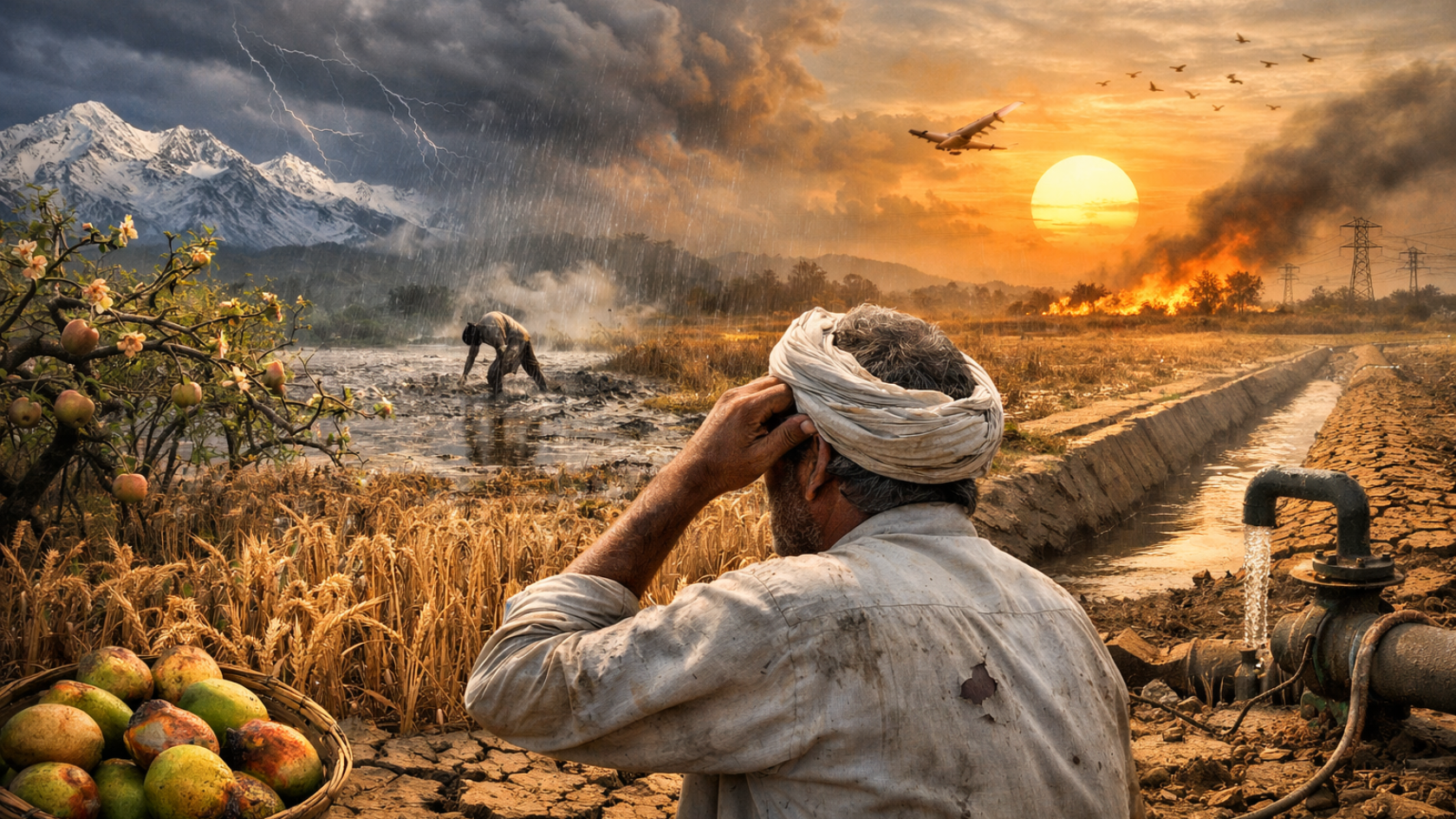
India is once again being caught unprepared by a climate crisis that is no longer “unusual” but increasingly routine. From the snow-deficit Himalayas to storm-hit plains, the warning signs are clear: rising temperatures, erratic rainfall, and fragile crop cycles. Yet, the policy response remains reactive, fragmented, and insufficient. While advisories and alerts from the India Meteorological Department are important, they do little to protect farmers who are already facing crop losses, rising costs, and growing uncertainty. Early budding in apple orchards, damaged mango flowers, and heat-stressed wheat are not isolated events, they are signals of a systemic failure to prepare agriculture for a warming world.
The government’s approach continues to rely heavily on short-term crisis management rather than long-term resilience. Crop insurance schemes remain unreliable and inaccessible for many small farmers, often failing to compensate for losses in time. Procurement policies are inconsistent, leaving farmers vulnerable to price crashes when production is good and helpless when crops fail. Despite repeated climate shocks since 2022, there has been little visible effort to diversify cropping systems or support region-specific climate adaptation. Instead, monoculture practices continue, increasing vulnerability to both weather shocks and pest attacks.
Equally concerning is the neglect of public investment in irrigation and local water systems. As temperatures rise and rainfall becomes erratic, farmers are forced to depend more on groundwater or expensive private solutions. This not only raises cultivation costs but also deepens inequality, as small and marginal farmers are the worst affected. At the same time, rising input costs, fertilisers, pesticides, and seeds, are quietly being passed down to farmers and eventually to consumers, fuelling food inflation. The burden of climate change is thus being shifted onto the most vulnerable, while policy remains disconnected from ground realities.
There is also a dangerous lack of preparedness for larger climatic risks such as a potential El Niño event, which could further disrupt monsoons and push India toward drought-like conditions. Despite clear scientific warnings, there is no visible nationwide strategy to manage its agricultural and economic fallout. Strengthening local storage, decentralised procurement, and climate-resilient seed systems should be urgent priorities. Instead, the policy discourse remains focused on exports, trade, and market signals, often ignoring the lived realities of farmers.
What India needs now is a decisive shift toward a pro-people, climate-resilient agricultural framework. This means investing in public irrigation, ensuring universal and effective crop insurance, promoting crop diversity, and building robust local food systems. Farmers must be treated not as passive recipients of relief, but as central stakeholders in climate adaptation. Without such a shift, the country risks not just periodic crop losses, but a deeper crisis of food security, rural livelihoods, and economic stability.
