
Days after the India AI Impact Summit 2026 wrapped up in New Delhi, news and digital media are flooded with news about the controversy studded event. While a lot of state backed media have done their usual, uncritical praise for the Government, even they haven’t been able to cover up the many failures and awkwardness that ran throughout the six day event.
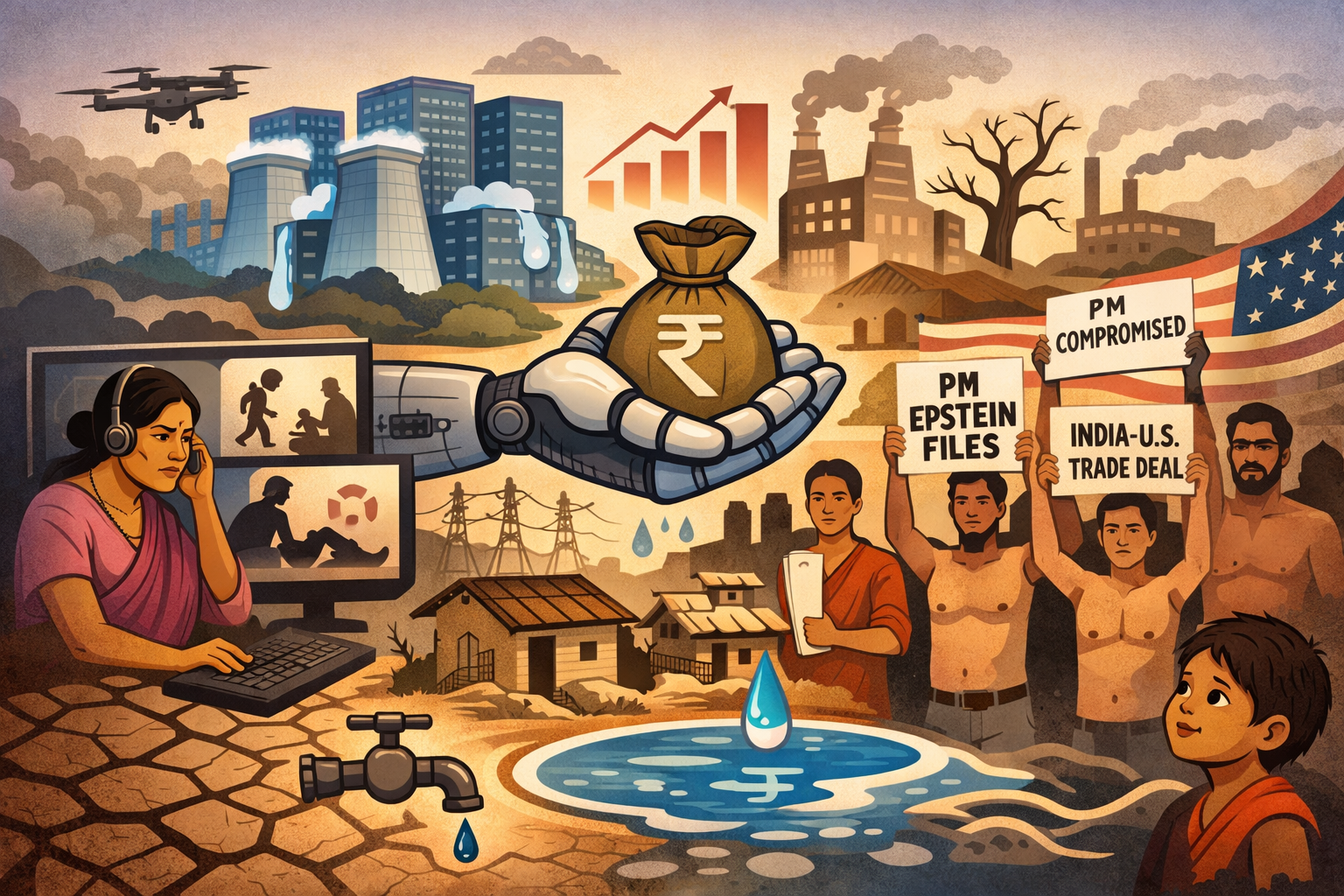
To begin with, the viral moment when the Prime Minister childishly asked AI company leaders to hold hands for a posed photograph and OpenAI’s Sam Altman and Anthropic’s Dario Amodei refused, grabbed a lot of headlines and eyeballs. But more seriously, a Chinese-made robot dog was presented at the summit as an Indian innovation; only for it to be quickly called out by participants and viewers online, leading to the University exhibiting this robot being asked to leave the summit. The most serious of all controversies, however, was the protest staged by Indian Youth Congress members who marched into the summit shirtless, holding up their t-shirts which read slogans including ‘PM is compromised’, ‘India-U.S Trade Deal’ and ‘Epstein Files.’
Despite its many distractions, there are a few things that stand out from the conference. Like AI company leaders’ interest in expanding data centres in India even as access to clean drinking water diminishes by the day. Or Mukesh Ambani’s plans to invest Rs. 10 trillion over the next seven years on AI. A total of 88 signatories, nations and organizations including, signed the voluntary, non legally abiding declaration at the summit which was apparently inspired by the principle ‘Sarvajana Hitaya, Sarvajana Sukhaya’ (For the good of all, for the happiness of all)
But if we look at whether AI is bringing good or happiness to all in India, the answer is an obvious no. Thousands of Indians, primarily rural women from oppressed castes, work in data annotation and content moderation for big tech companies across the globe. And as part of their content moderation jobs, these women watch hours of violent footage – ranging from gory, detailed sexual abuse incidents to fatal accidents – in order to categorise them and train AI to recognise violence, abuse and harm.
AI data centres’ massive water usage is no secret. GB Nagar, near Delhi, is emerging as one of India’s largest data centre hubs. And within years of it starting, the residents in the region are already facing water woes. This pattern is predicated to replicate itself wherever data centres are established, especially in already water stressed areas like Hyderabad.
Currently, India seems to be at its lowest in terms of citizens’ welfare. Wealth disparity and household debts are constantly increasing, the rupee is constantly dropping, climate crises are growing in intensity and frequency, jobs are getting scarcer. In a time like this investing critical money, resources and energy into AI – something that will only deepen the already steep socioeconomic cracks in Indian society – shows how little the government is bothered with public welfare and security. And further cements the fact that under this government, all citizens, our labour, land, water and air, all of it is for sale.
