
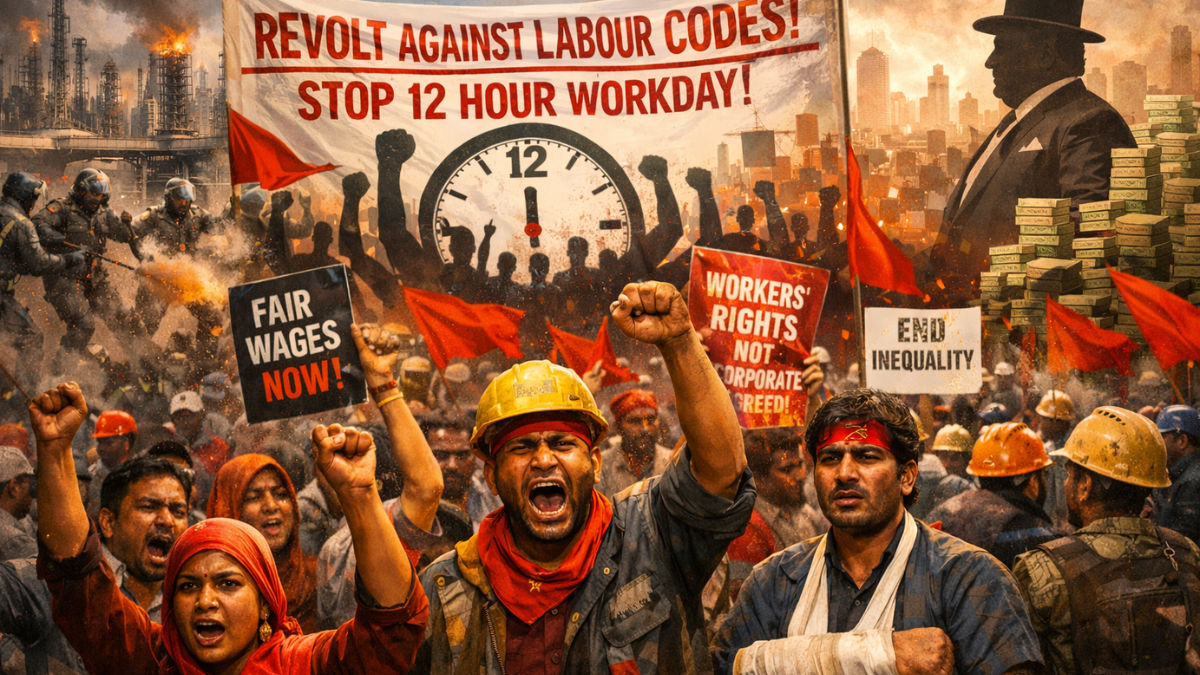
February was a long month of protests for Indian workers. To begin with: a general strike organised by a joint committee of trade unions saw the participation of over 30 crore workers! On February 12, workers across the country came together to demand the repeal of the four labour codes that are blatantly anti-worker and pro-corporate. One of the key tenets of these codes are the “flexible” work day sham that allows for workers to work up to 12 hours a day. It is accompanied by the clauses that mandate overtime pay for such work and claim that a work week cannot exceed 48 hours of work. But for a government notorious for evading responsibility and accountability, will these clauses even matter?
If recent events in the country are evidence then the answer is a resounding no. Towards the end of February, thousands of workers protested at the Indian Oil Corporation Ltd (IOCL) refinery in Haryana’s Panipat. Their demands were beyond simple. They wanted work to be reduced from 12 hours to eight, they wanted basic facilities like washrooms and drinking water and they demanded that they be paid on time. All very basic expectations that should have been already ensured and enforced. Yet during the protests, frequent violence from CISF and the police led to several workers being injured including one of them ending up with a broken arm. Only after this did the company give in to the workers’ demands.
Around the same time, inspired by the Panipat protests, over 2000 workers from L&T in Gujarat’s Hajira have been protesting demanding better working conditions and better pay. Only to be met with tear gas and police violence.
India is one of the worst countries when it comes to wealth inequality with the top 1% of the population owning a whopping 40% of the country’s wealth! Living under billionaire raj means protecting the greed of the uber rich at the cost of workers’ rights and dignity. In this context, no amount of PR or whitewashing can fool the workers’ to believe that the labour codes are for their benefit. A move that will convince the workers that their government is on their side will be to levy a wealth and inheritance tax on the top 1%, something that seems so far fetched to demand from this government. So until that happens, workers’ protests will grow and become the norm in India.
Centre for Financial Accountability is now on Telegram and WhatsApp. Click here to join our Telegram channel and click here to join our WhatsApp channel and stay tuned to the latest updates and insights on the economy and finance.
